








Mileage reimbursement is the amount an employer pays an employee to cover usage of their personal vehicle for work, such as fuel, maintenance, and wear. It is calculated from the kilometres driven for business, multiplied by a per-kilometre rate. The Canada Revenue Agency treats it as an allowance for the use of a motor vehicle.
What is mileage reimbursement used for?
Mileage reimbursement is used to compensate an employee who uses their personal vehicle for work. It covers the costs of that travel without the employee having to itemize each fuel or maintenance expense.
It takes two main forms. The first is an allowance based on a per-kilometre rate: the employer pays a set amount for each business kilometre driven. The second is a reimbursement of actual costs: the employee keeps their receipts and is reimbursed for a share of their vehicle costs, in proportion to business use.
This travel generally excludes the trip between home and the regular workplace, which is treated as personal. It covers trips taken for work: a client visit, a drive between two service locations, or an errand for the employer.
How is mileage reimbursement calculated?
An allowance is calculated by multiplying the business kilometres by a per-kilometre rate. The Canada Revenue Agency publishes a per-kilometre limit each year. It sets the amount an employer can pay while keeping the allowance exempt from tax. For 2026, that limit is $0.73 per kilometre for the first 5,000 business kilometres, then $0.67 per kilometre beyond that. In Yukon, the Northwest Territories, and Nunavut, it is increased by $0.04 per kilometre.
The calculation relies on a mileage logbook. For each business trip, the employee records the date, the destination, the business reason, and the number of kilometres. Without this logbook, the allowance can be denied during a review. An employee who chooses actual costs instead keeps a record of all their kilometres, business and personal, to establish the proportion of business use of their vehicle.
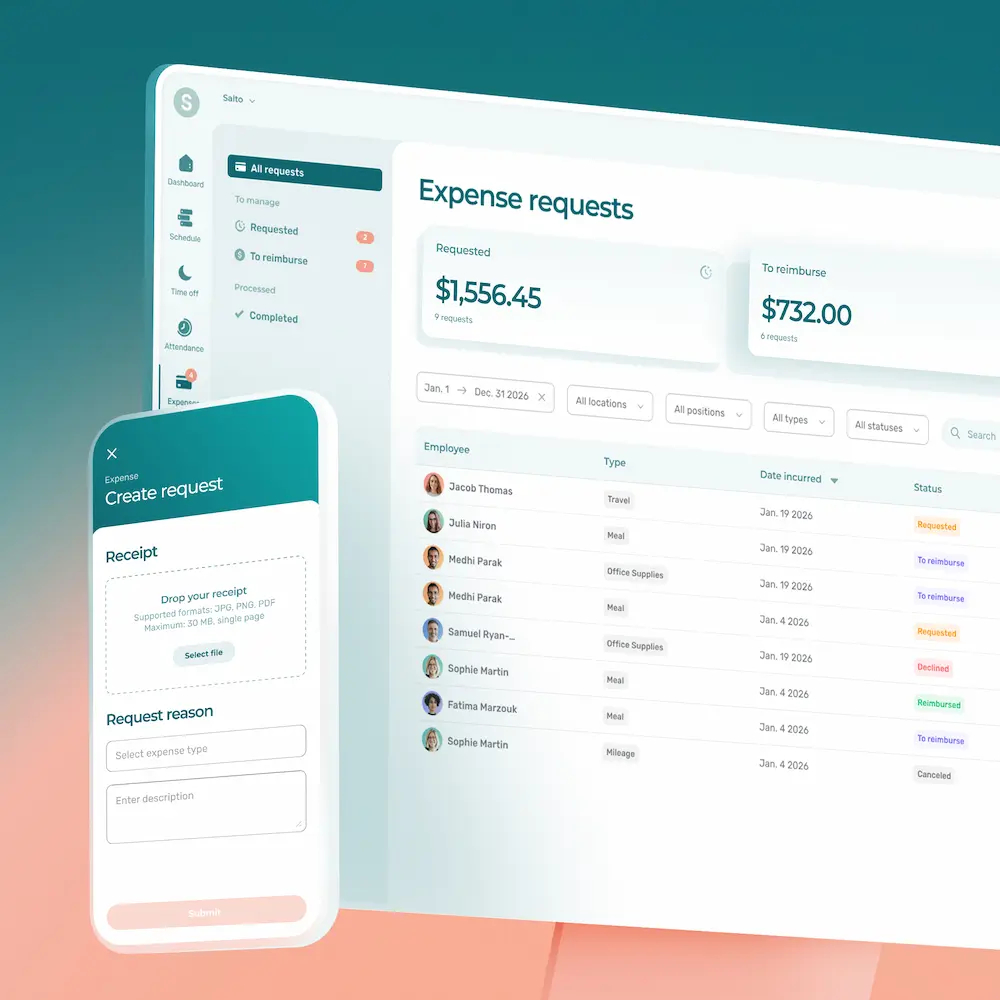
An expense management tool records these kilometres and applies the current rate. To log trips consistently from one claim to the next, a ready-to-use expense report template serves as a starting point.
Is mileage reimbursement taxable?
As a rule, a reasonable allowance is not taxable. The employee gets back an amount that matches their vehicle costs; it is not treated as pay. It therefore does not appear on their T4 slip, the year-end statement used to file the income tax return.
An allowance is considered reasonable when it is based only on business kilometres and the employer does not also reimburse the same vehicle costs separately. The per-kilometre rate generally stays within the published limit. An allowance that does not meet these conditions becomes taxable. That is the case for a fixed flat amount paid without regard to the kilometres driven, which the employer must then add to the employee’s T4 slip.
How long must an employer keep a mileage logbook?
The mileage logbook and its supporting records are kept for six years. The six-year count runs from the end of the last tax year concerned. The Canada Revenue Agency sets this requirement.