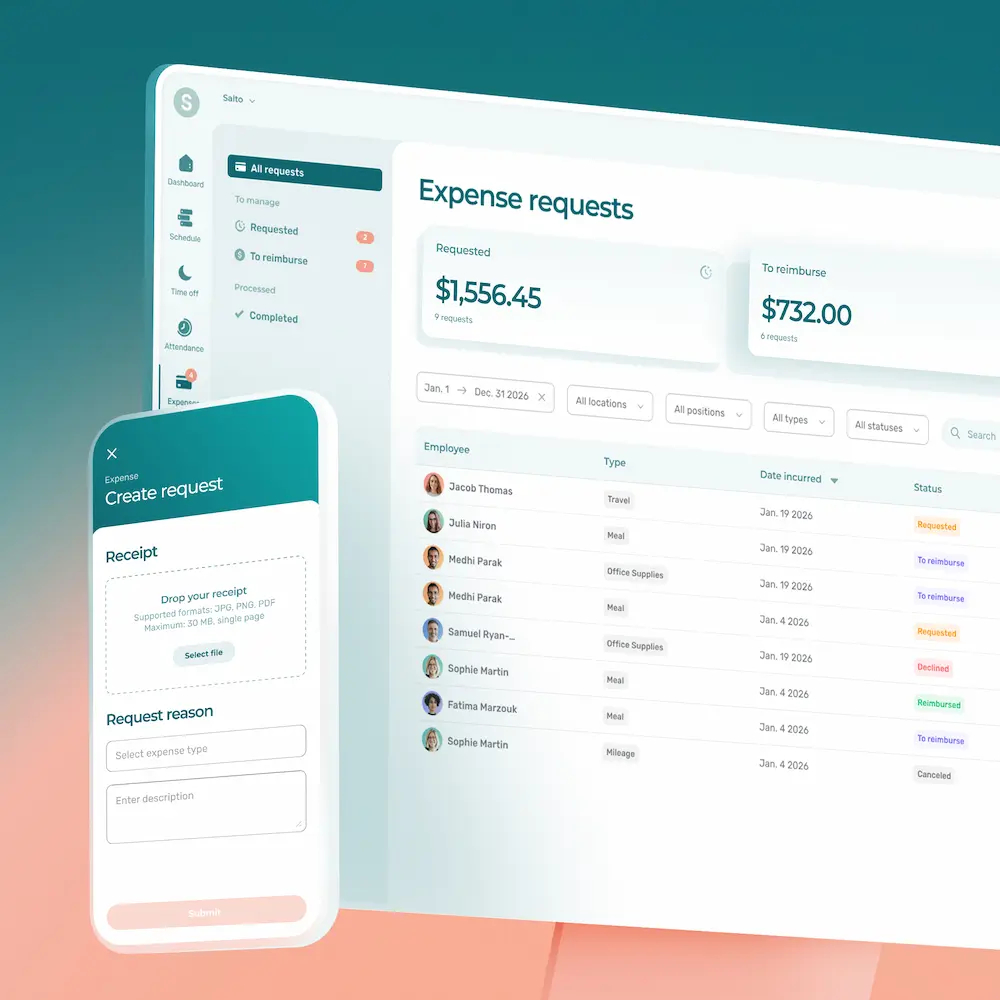










Expense management is the process a company uses to handle the business expenses its employees incur, from the moment a claim is submitted through to reimbursement and recording. It governs how each expense moves between the employee, the manager, and accounting.
What is expense management used for?
Expense management is used to handle, in a consistent way, the business expenses an employee takes on for work and gets reimbursed for. It defines the steps each claim follows, from entry to payment, and the rules that frame it.
It serves three functions. It establishes what the company reimburses and to whom. It gives accounting data that is tied to proof and to an internal policy. And it maintains a verifiable trail in case of a Canada Revenue Agency review.
Expense management differs from an expense report. The expense report is the document an employee uses to request reimbursement. Expense management is the process that receives that document, validates it, pays it, and records it.
What are the stages of expense management?
Expense management moves through four stages, from the point an expense is incurred to its recording for audit purposes.
- Submission. The employee enters the expense and attaches supporting proof, often using an expense report template or an internal form.
- Approval. The manager checks the expense against company policy, then approves or rejects it. A higher amount sometimes passes through a second level of review.
- Reimbursement. The company pays the approved amount to the employee, often with their pay.
- Recording. Accounting assigns the expense to the correct account and keeps the supporting proof.
Companies generally frame this cycle with an expense policy: it sets the eligible categories, the limits, and the proof required, which keeps handling consistent from one claim to the next.
How long must expense records and receipts be kept?
Expense records and their supporting receipts are kept for six years. That period starts from the end of the last tax year they relate to. This rule comes from the Canada Revenue Agency and provincial entities such as Revenu Québec, and it applies to all expenses handled, whatever tool is used.
What sets good expense management apart?
Expense management is judged on three points.
- Traceability: each expense is tied to supporting proof and to an approval.
- Compliance: handling follows internal policy and the applicable tax rules.
- Timing: reimbursement reaches the employee within a predictable window.
Manual handling, by email and spreadsheet, meets these conditions at a low volume of claims but becomes hard to sustain as their number grows. An expense management tool centralizes submission, approval, and tracking in one place.