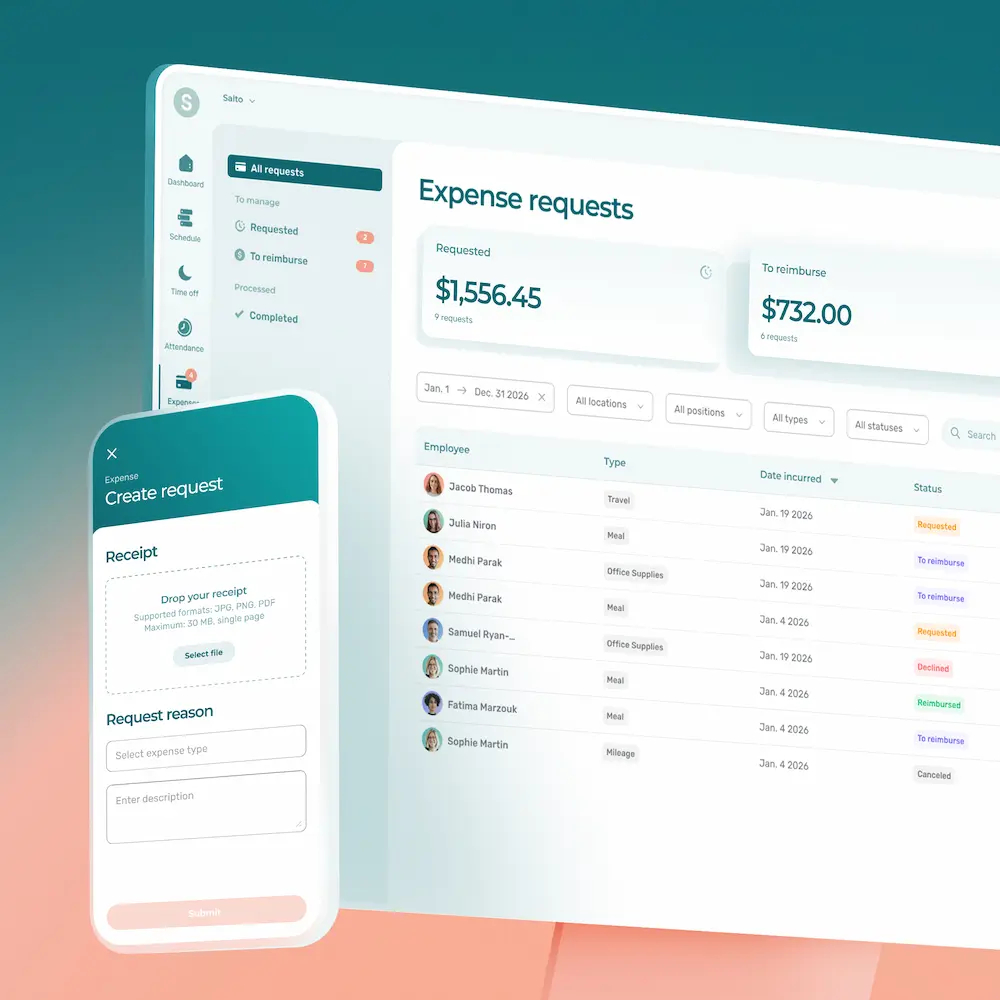









An expense report is a document an employee uses to request reimbursement for business expenses they paid for themselves. It brings together the amounts spent for work, such as travel, meals, or supplies, along with the receipts that prove them. It is the record that allows an employer to reimburse the employee and keep proof of the expense for its records.
What is an expense report used for?
An expense report is used to reimburse an employee for an expense they took on for work. It documents that expense as a reimbursement request, dated and backed by proof.
It serves three functions. It establishes the amount to be paid back to the employee. It gives the employer a verifiable record for its accounting. And it supports the company’s expenses during a Canada Revenue Agency or Revenu Québec review.
An expense report differs from an allowance. It reimburses a real expense that is already paid and backed by a receipt. An allowance is a fixed amount paid in advance, which the employee does not have to break down receipt by receipt. That distinction affects the tax treatment, covered below.
What does an expense report contain, and how does it work?
A complete expense report brings together the details an employer needs to validate the expense: the employee’s name, the date, the nature of the expense, the amount, and the business reason. For a meal or a client meeting, the report also notes the client’s name and the purpose of the meeting. Missing context is one of the first reasons a claim is denied during a review.
Each expense should be backed by supporting proof, meaning a document that shows the purchase: an invoice, an itemized receipt, or a transit ticket. A bank statement on its own is rarely accepted by the Canada Revenue Agency. Without a receipt, an expense is generally not reimbursed. To keep these details consistent from one claim to the next, a ready-to-use expense report template gives you a starting point.
An expense report moves through four stages:
- The employee pays the expense and keeps the receipt.
- They fill out the report and submit it.
- The manager reviews it, then approves or rejects it.
- The employer then reimburses the employee, often with their pay.
An expense management tool brings these stages together in one place.
Is an expense reimbursement taxable?
As a rule, the reimbursement is not taxable. The employee gets back an amount they had advanced for work; it is not income. It therefore does not appear on their T4 slip, the year-end statement used to file the income tax return.
Two situations change this. If the reimbursement is more than the real expense, the surplus is treated as income for the employee, and the employer must add it to their T4 slip. If the reimbursement covers a personal expense, it is taxable. The receipt is what confirms that the reimbursement is non-taxable.
Some expenses follow additional rules: meal and entertainment costs, for example, are generally 50% deductible for the business.
How long must an employer keep receipts and expense reports?
On the employer’s side, the expense report and its receipts are kept for six years. That period starts from the end of the last tax year involved. This rule comes from the Canada Revenue Agency and provincial entities like Revenu Québec.