






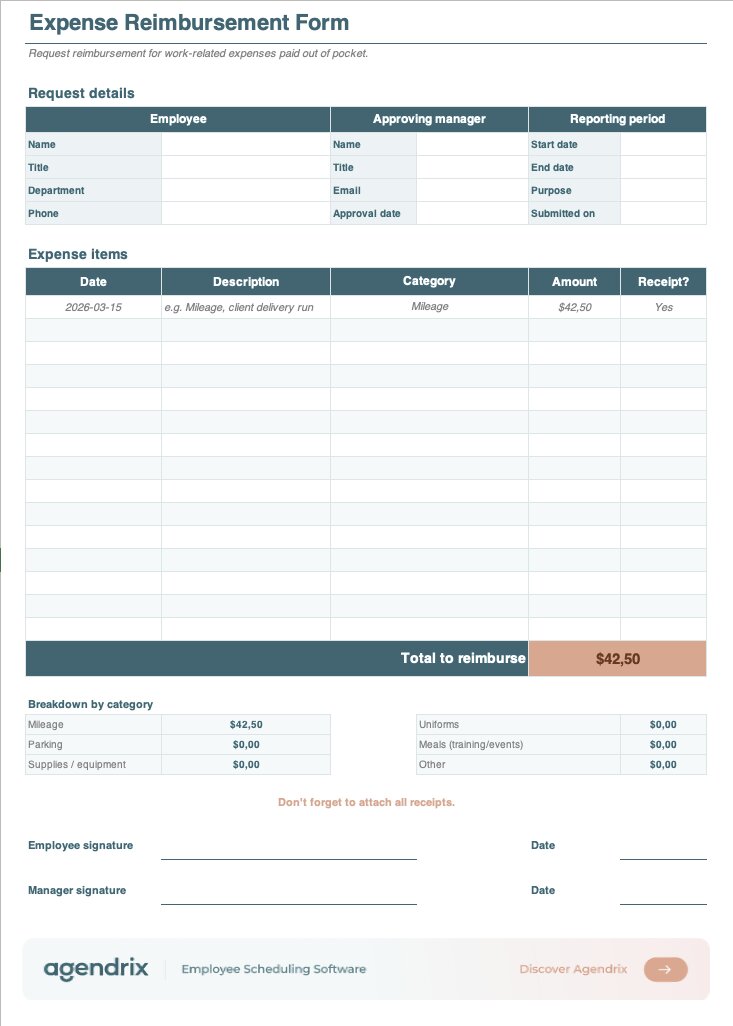
Expense Reimbursement Form
Standardize how your team gets paid back for work expenses. This free expense reimbursement form lets employees log what they spent and managers approve it in minutes, with a category dropdown and auto-calculated total built in. Made for small and shift-based teams that want a clean, repeatable process.

To which address should we send your resource?
What is an expense reimbursement form?
An expense reimbursement form is a document an employee uses to request payback for specific work-related costs they paid out of pocket. It typically lists the date, a short description, a category, and the amount for each expense, along with the reporting period and the manager who approves it.
Most employers require a matching receipt for every item, and many forms track that directly. The form gives businesses a clear, consistent record of what was spent, why, and who signed off, which keeps reimbursement organized and easy to track.
What’s the difference between an expense report and a reimbursement form?
The two overlap, and some businesses use the terms interchangeably. The distinction is one of scope. An expense report is usually a broader document that lists multiple business expenses over a set period, often a week or a month, grouped by category and used for accounting and budget tracking.
A reimbursement form is typically simpler and more transactional: it focuses on paying an employee back for specific expenses, usually with receipts attached. The right choice depends on how formal your process needs to be.
What expenses are typically reimbursable?
Reimbursable expenses are generally the legitimate, work-related costs an employee pays out of pocket. For shift-based and small business teams, common examples include mileage for using a personal vehicle, parking, supplies or equipment, uniforms where the employer requires them, and meals during approved training or company events.
What qualifies depends on your industry and your internal reimbursement policy. A clear written policy, paired with required receipts, is the simplest way to avoid confusion about what the business will and will not pay back.
How long does an employer have to reimburse an employee?
Timelines vary by jurisdiction and by internal policy. Many employers process reimbursements on the next pay cycle, with a typical turnaround of a few weeks. Some provinces set explicit deadlines, while others leave it to the employer’s discretion.
The practical takeaway is to set a clear reimbursement timeline in your employee handbook and apply it consistently, which avoids disputes and keeps employees confident that legitimate expenses will be paid back promptly.
How do you streamline reimbursement for hourly or shift-based teams?
A template like this one is a good starting point to standardize how your team submits expenses. But for hourly or shift-based teams, manual spreadsheets get hard to manage fast, especially when employees work across multiple locations or rotating schedules.
Expense management software lets employees submit expenses directly from their phone, attach receipt photos on the spot, and gives managers one place to review and approve everything. It cuts down on paperwork, speeds up reimbursement, and keeps records clean even when your team is spread across sites and shifts. Agendrix brings expense submission and approval into the same platform your team already uses for scheduling and time tracking.