Cell Phones at Work: What the Law Says in Canada and 5 Practical Solutions for Managers


Key takeaways
- Cell phones at work are costly: both concentration and safety take a hit.
- Canadian law doesn’t ban them, but employers’ management rights allow restrictions, or even a full ban in certain contexts.
- The best cell phone policy at work is one people actually understand: clear, fair, communicated in person, and enforced by everyone, managers included.
- A dedicated team communication tool eliminates the top excuse for pulling out a personal phone during a shift.
Your cook is checking TikTok in the middle of a lunch rush. Your care attendant is texting between patients. Your clerk is scrolling through notifications instead of helping customers. Cell phones at work are the problem everyone sees but no one wants to deal with.
An employee is three times more likely to make a mistake after receiving a single notification, even if they don’t look at it, according to a Florida State University study.
Cell phones are everywhere. They’re used to check the schedule, coordinate teams, and respond to customers. The problem is that the same device also gets used to scroll Instagram between tasks. And as the study shows, it doesn’t even need to be opened to cause damage.
The Real Cost of Cell Phones at Work
Matthew manages a restaurant in Winnipeg. Lunch rush, dining room packed. One of his cooks grabs his phone to check a message. Thirty seconds. A dish burns, an order falls behind, a customer leaves unhappy. Multiply that by five employees, five days a week. Cell phones don’t just cost time. They cost money, hurt your reputation, and drain your team’s energy.


On one hand, concentration. A single notification is enough to break a focus cycle. For a pharmacy technician filling prescriptions or a care attendant in a long-term care home, every interruption raises the risk of error. And in teams with variable schedules, where the pace changes from one shift to the next, each extra notification is one more thing on an already full plate.
On the other, safety. Using a phone in a warehouse, a kitchen, or near heavy equipment is a real risk. Employers have a legal obligation to protect the health and safety of their team. An employee distracted by a text, in the wrong context, can end up in an incident report.
And then there’s physical health. In March 2026, Quebec’s Tribunal administratif du travail (TAT) recognized that tendinitis from repeated cell phone use in the workplace constituted an occupational disease. The worker used her phone all day to carry out her duties, according to a ruling reported by Le Devoir.
Even though the context differs from an employee scrolling on the sly, the takeaway is the same: cell phones at work are now a recognized health issue in the eyes of the courts. For managers across Canada, it’s one more reason to set clear boundaries.
What the Law Says in Canada
In Canada, no federal or provincial law explicitly bans cell phone use at work. Labour standards legislation across the country is silent on the topic. It’s a gap in the law, not a right.
Employers, however, hold management rights recognized by courts and labour boards in every province. These rights let employers set reasonable rules around personal device use at work: restricting, regulating, or even banning cell phones entirely during shifts. The condition? The rules must be written, known to all, and enforced consistently.
In sensitive environments (seniors’ residences, restaurant kitchens, pharmacies), restrictions are even easier to justify. Hygiene, confidentiality, safety: there’s no shortage of reasons. And every province has occupational health and safety legislation that requires employers to take reasonable steps to protect workers. The 2026 TAT ruling in Quebec, which recognized cell phone use as a source of occupational disease, signals that courts are paying attention.
5 Practical Solutions to Manage Cell Phone Use at Work

1. Write a Clear Policy (More Than Just “No Phones”)
Karim owns a pharmacy in Moncton. His cell phone policy takes up a few lines: personal phones stay in the locker during shifts, except on breaks. For emergencies, the employee notifies the pharmacist on duty and takes the call in the back room. The document was signed by every employee at hiring. It’s posted in the break room.
That’s what a working cell phone policy looks like: short, specific, with clear consequences (verbal warning, written warning, disciplinary action) and ongoing visibility through an internal newsfeed. Not a 12-page document nobody will read.
2. Create Phone-Free Zones and Times
A total ban creates pushback. Zone-based rules create clarity.
Sarah manages a retail store in Kelowna. Phones are banned on the sales floor during business hours but allowed in the back store. Her team finds it fair because it’s realistic. Nobody lives in a bubble. But nobody should be scrolling their feed in front of customers either.
3. Centralize Communications in a Dedicated Tool
Schedules arrive by text. Shift swaps go through Messenger. Team announcements land in a Facebook group. When all work communication lives on personal phones, it’s no wonder the phone never leaves anyone’s hand.
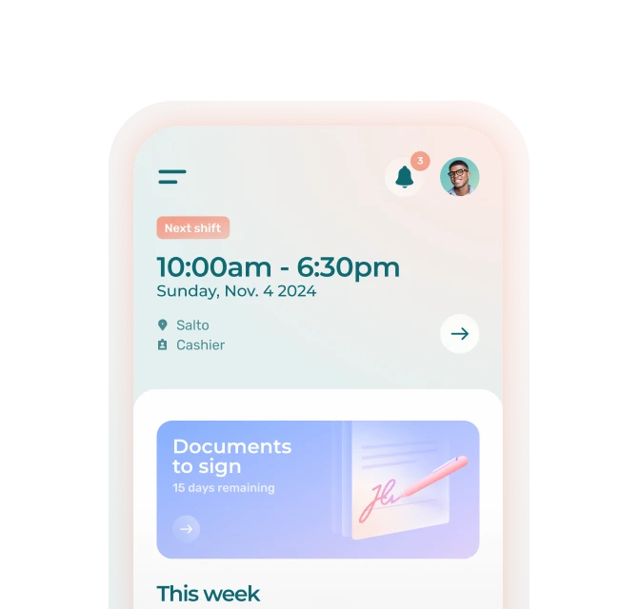
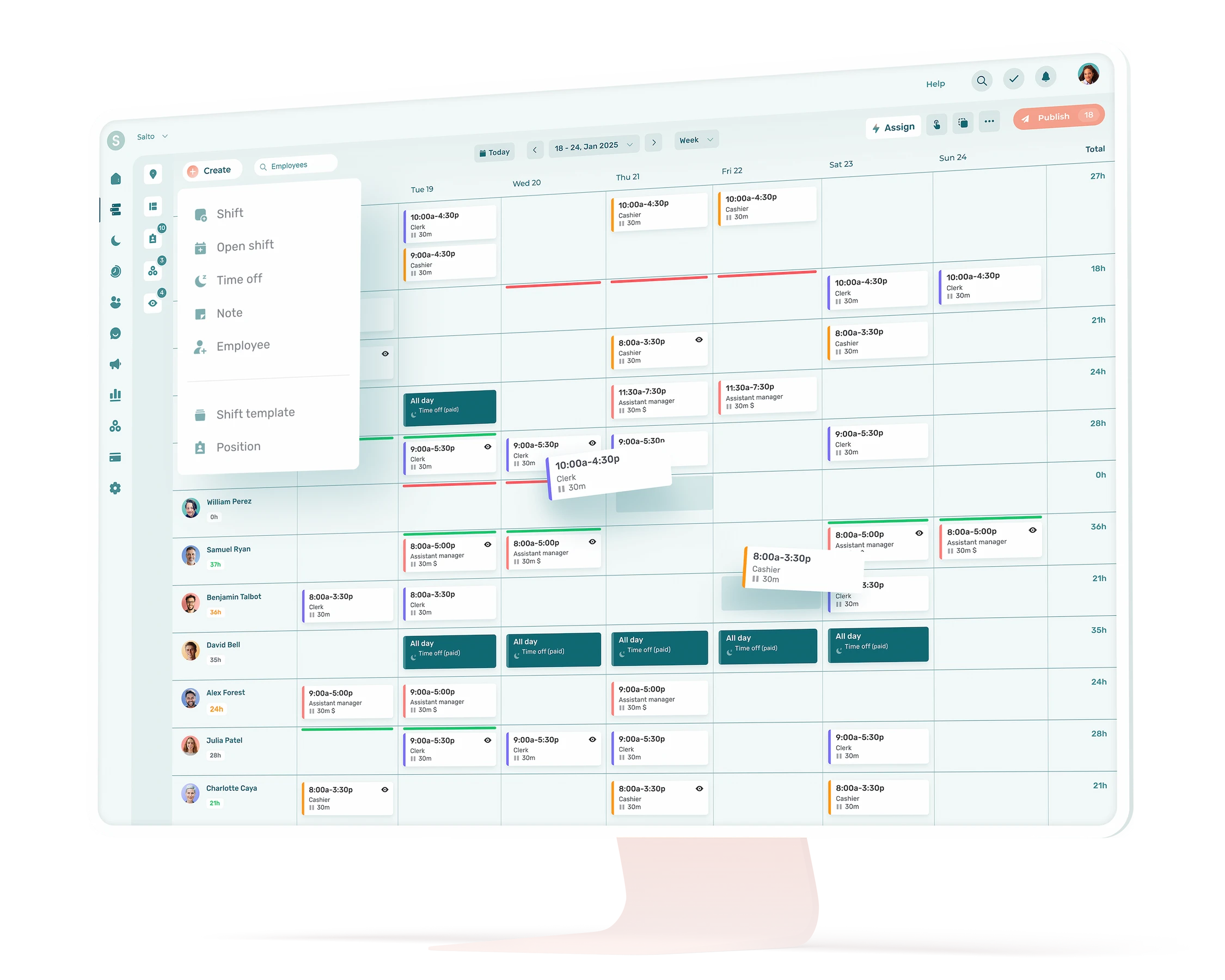
By centralizing everything in a tool like Agendrix, you separate the channels. The employee still uses their phone, but they open a work app, not Messenger or Facebook. Schedule notifications, requests, and announcements all live in one place, away from social feeds and distractions. The “just checking something” excuse no longer leads anywhere else.
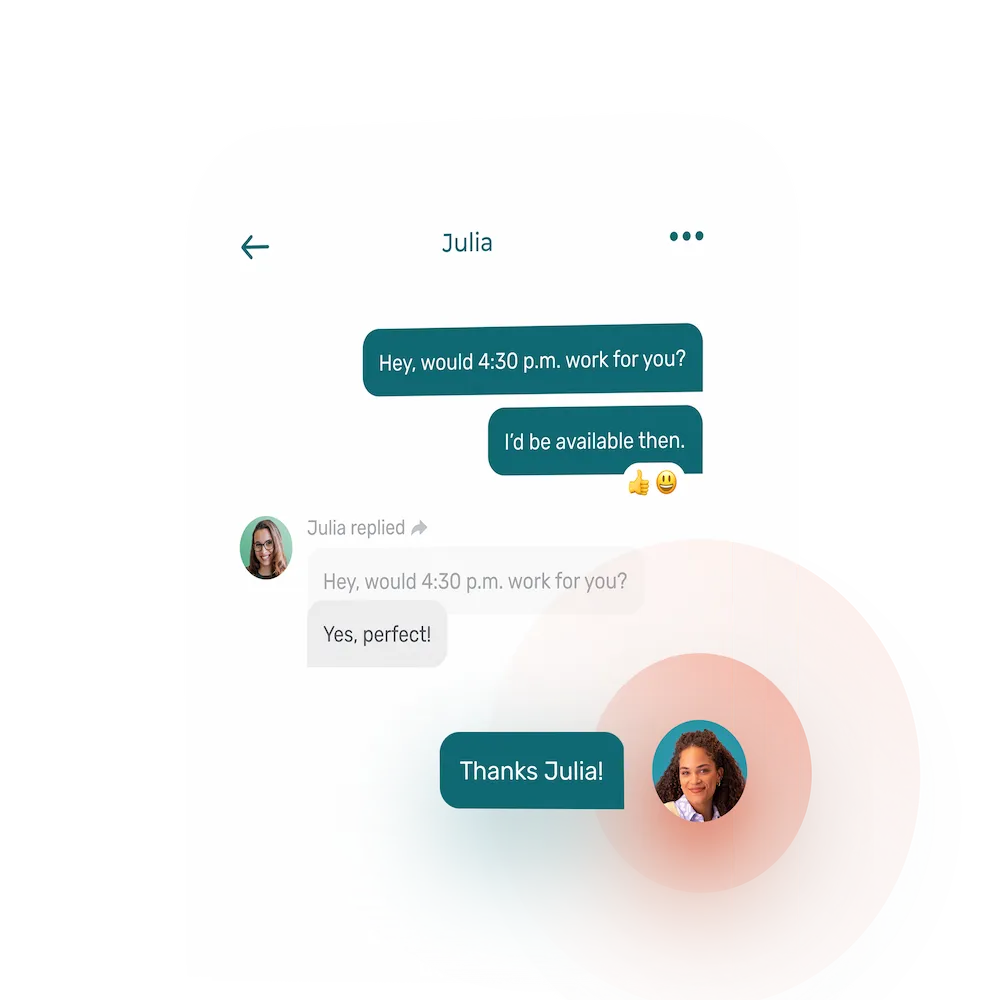
When work messages come through a dedicated app instead of Messenger, there’s no reason to open the apps that cause distractions.

4. Lead by Example (Yes, You Too)
You know the scene: the manager calls out an employee for being on their phone, then walks back to their work station to check their own. A policy’s credibility is built right there. If you’re on the floor, the same rules apply to you. No exceptions. That’s the difference between a policy people respect and a piece of paper they ignore.
5. Plan for Exceptions
No policy should prevent an employee from answering when daycare calls or a parent is hospitalized. Set up a simple procedure: the employee notifies their supervisor, steps away briefly, and comes back. This kind of flexibility shows respect for your employees, and it’s often what makes the difference between a rule people follow and one they resent.
Nadia, the director of a seniors’ residence in Fredericton, tried a total ban. It didn’t last. Today, her rule is simpler: phones stay on silent mode, in your pocket during care, but they don’t come out. On breaks, staff can do as they please. And for emergencies, attendants notify the unit supervisor and step away briefly. Less confrontation, more clarity.
How to Communicate Your Cell Phone Policy Without Being Seen As the Bad Guy
You don’t have rules in place and you’d like that to change? Make sure you roll it out the right way. Posting your new policy in the Messenger group on a Thursday night at 8:45 PM doesn’t cut it. What works is presenting it during a team meeting, face to face with your entire team, not just new hires. Explain the why before the how: “Three orders were messed up in the last two weeks, two of them linked to distractions” hits harder than a generic message.

Then make it impossible to ignore. Post it in the break room, include it in the employee handbook, and share it through your HR app’s internal newsfeed. For new hires, build it into the onboarding process, right alongside the punctuality policy and the dress code.
Keeping the Policy Alive Day to Day
Communicating the policy is half the job. The other half is making it stick. Document violations in employee records: a verbal warning noted, a written warning if it happens again. Not to punish, but to keep a clear and consistent record. Bring it up during one-on-ones, especially in the first few weeks after rollout. That’s usually when habits form.
After a month or two, check in with your team. A short internal survey is enough: is the policy clear? Are there fewer distractions? Should anything change? It gives you real data, and it shows your employees that their input matters.
The Right Tool, the Right Rules, the Right Example
Cell phones at work aren’t going away. But the ambiguity around their use is easy to lift. A clear policy, a tool that separates work communication from personal apps, and a manager who respect their own rules. The rest follows.
👉 See how Agendrix replaces texting, Messenger, and Facebook groups for team communication.
Can an employer ban cell phones at work in Canada?
Yes. No Canadian law prevents an employer from restricting or banning personal cell phone use during work hours. This right stems from the employer’s management rights, recognized by courts and labour boards across the country. The restriction must be reasonable, applied consistently, and communicated in writing.
Is there any legislation on cell phone use at work in Canada?
There is no specific legislation on cell phones at work. However, every province has occupational health and safety laws that require employers to protect workers. In March 2026, Quebec’s Tribunal administratif du travail recognized that repeated cell phone use at work could constitute an occupational disease, setting a notable precedent.
How do you write a cell phone policy at work?
Specify the zones and times where phones are allowed or banned, the consequences for non-compliance, and exceptions for personal emergencies. Write it in plain language, have it signed at hiring, and post it in common areas. Present it at a team meeting rather than by email.
What are the risks of not having a cell phone policy at work?
Without a written policy, managers face productivity losses, safety risks, team conflicts, and potentially workplace injury claims if cell phone use causes a recognized incident.