

Key takeaways
- In Canada, tips belong to the employee who earned them. Employers cannot keep or redirect tips, with very limited exceptions.
- Tip pooling is legal in most provinces, but the rules around employer involvement vary significantly.
- Quebec has the strictest framework: a tip-sharing agreement must be initiated and approved by employees themselves, with no employer interference.
- A tip management tool connected to your timesheets eliminates calculation errors and keeps your team informed.
Wondering what the rules are around tip pooling in Canada? Here is a plain-language breakdown of the laws by province, what you can and cannot do as an employer, and how to handle tip distribution without the manual math.
Tips are a significant part of compensation in hospitality and food service.
According to the Quebec Restaurant Association (ARQ), tips represent 60% to 70% of total compensation for restaurant employees in Quebec.
Across Canada, the picture is similar in most provinces: for servers, bartenders, and front-of-house staff, tips are not a bonus. They are a core part of the paycheque.
That is why tip pooling, when it is done poorly or without a clear legal foundation, creates real problems: disputes between staff, complaints to labour boards, and turnover you could have avoided.
What Is Tip Pooling?


Tip pooling (also called tip sharing) is a practice where some or all tips collected by customer-facing employees are redistributed to other team members, such as kitchen staff, bussers, or hosts, who do not receive tips directly.
It is distinct from a tip-out, where a server individually passes a portion of their tips to support staff at the end of a shift. A tip pool collects everyone’s tips into a shared pot before redistribution.
Both practices are legal in Canada, but each province has its own rules.
Tip Pooling Laws by Province
Quebec
Quebec has the most defined legal framework in Canada for tip sharing arrangements. Under Article 50 of the Act Respecting Labour Standards, tips belong to the employee who rendered the service. Employers cannot retain tips, impose a sharing system, or interfere in any way with how employees choose to distribute them.
A tip-sharing agreement in Quebec must be initiated and voted on by the employees themselves, with approval from a majority (50% + 1) of eligible workers. The agreement must specify the redistribution percentage, which positions are included, the calculation method, payment frequency, and the person responsible for distribution.
The employer’s role is limited to informing staff that a CNESST model agreement exists (French only). Nothing more.
Ontario
Ontario’s Employment Standards Act prohibits employers from keeping any portion of an employee’s tips or directing how they are shared, with one exception: an employer who also performs the same work as employees (such as an owner who actively waits tables) may participate in a tip pool.
Tip pooling policies in Ontario must be posted in the workplace and applied consistently.
British Columbia
BC’s Employment Standards Act explicitly allows employers to require that tips are redistributed through a tip pool. This makes BC notably different from Quebec and Ontario, where employer-imposed tip pooling is prohibited.
That said, employers in BC may not take a share of the pool themselves unless they perform similar work to the employees receiving tips. They also cannot withhold tips or force employees to give up tips outside of a legitimate pooling arrangement.
Alberta
Alberta has no specific tip pooling legislation. Tips are considered the property of the employee, and employers cannot withhold them. Any internal tip-sharing arrangement should be clearly communicated and consistently applied to avoid disputes.
Other provinces
Most other provinces follow a similar baseline: tips belong to employees, employers cannot take a cut, and internal tip-sharing arrangements are generally permitted when employees agree. New Brunswick, Nova Scotia, PEI, and Newfoundland have all introduced legislation in recent years prohibiting employer tip retention.
If you operate outside Quebec, check your province’s employment standards website for the most current rules, as this area of law has been evolving across Canada.
What Employers Can and Cannot Do


Regardless of province, a few rules apply broadly across Canada:
Employers cannot:
- Keep any portion of tips for themselves (unless they actively perform the same work as tipped employees, in some provinces)
- Use tips to top up wages to minimum wage
- Force employees into a tip-sharing arrangement
Employers can:
- Inform staff about the option of a tip-sharing arrangement
- Facilitate the logistics of distribution (calculating amounts, processing payments) once a system is agreed upon by staff
- Set policies around tip declaration and record-keeping
How to Manage Tip Distribution Without the Manual Math
Most restaurant managers handle tip distribution the same way: a notebook, a spreadsheet, and a conversation at the end of a busy Friday night. It works until someone questions the numbers, and then it does not.
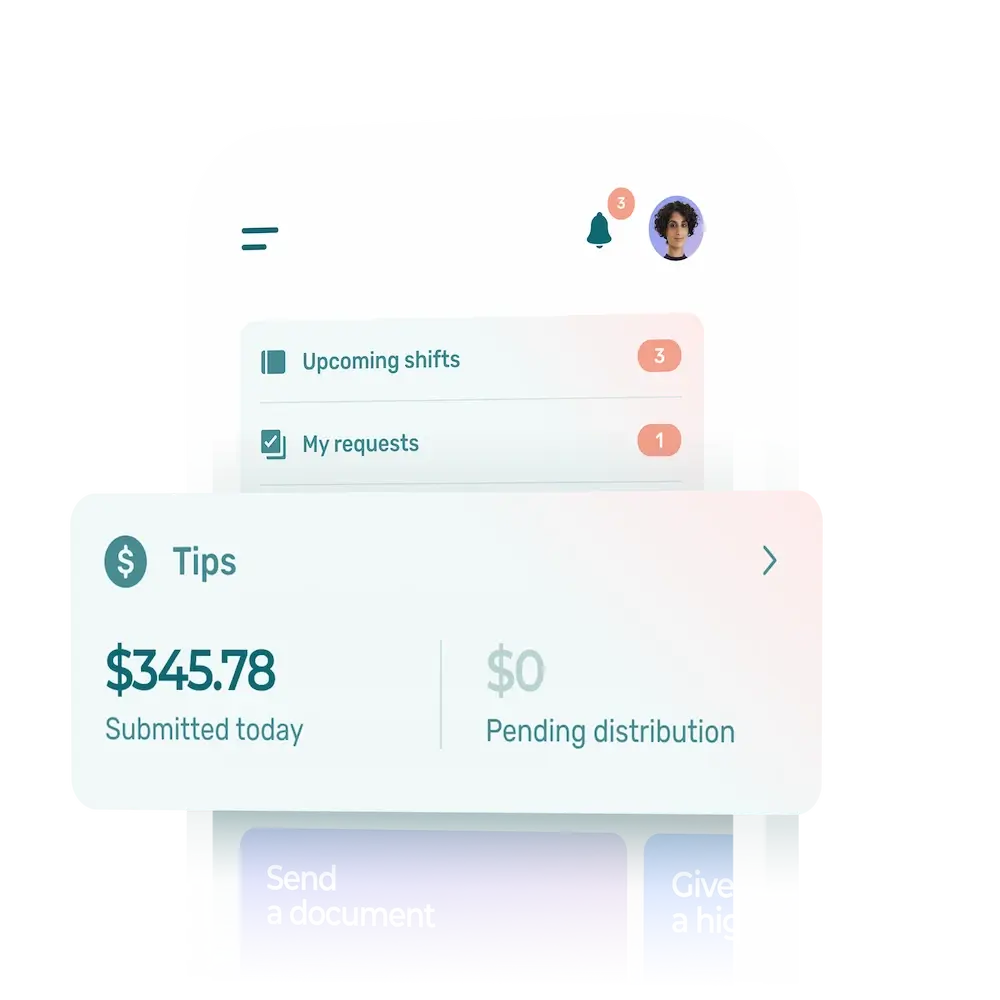
With Agendrix’s tip pooling feature, employees log their tips directly in their timesheet. The app applies your distribution rules automatically and produces a clear report for payroll. Everything is centralized with your schedules, time tracking, and payroll prep, and it exports to your payroll software in one click (QuickBooks, Nethris, Ceridian Powerpay, and more).
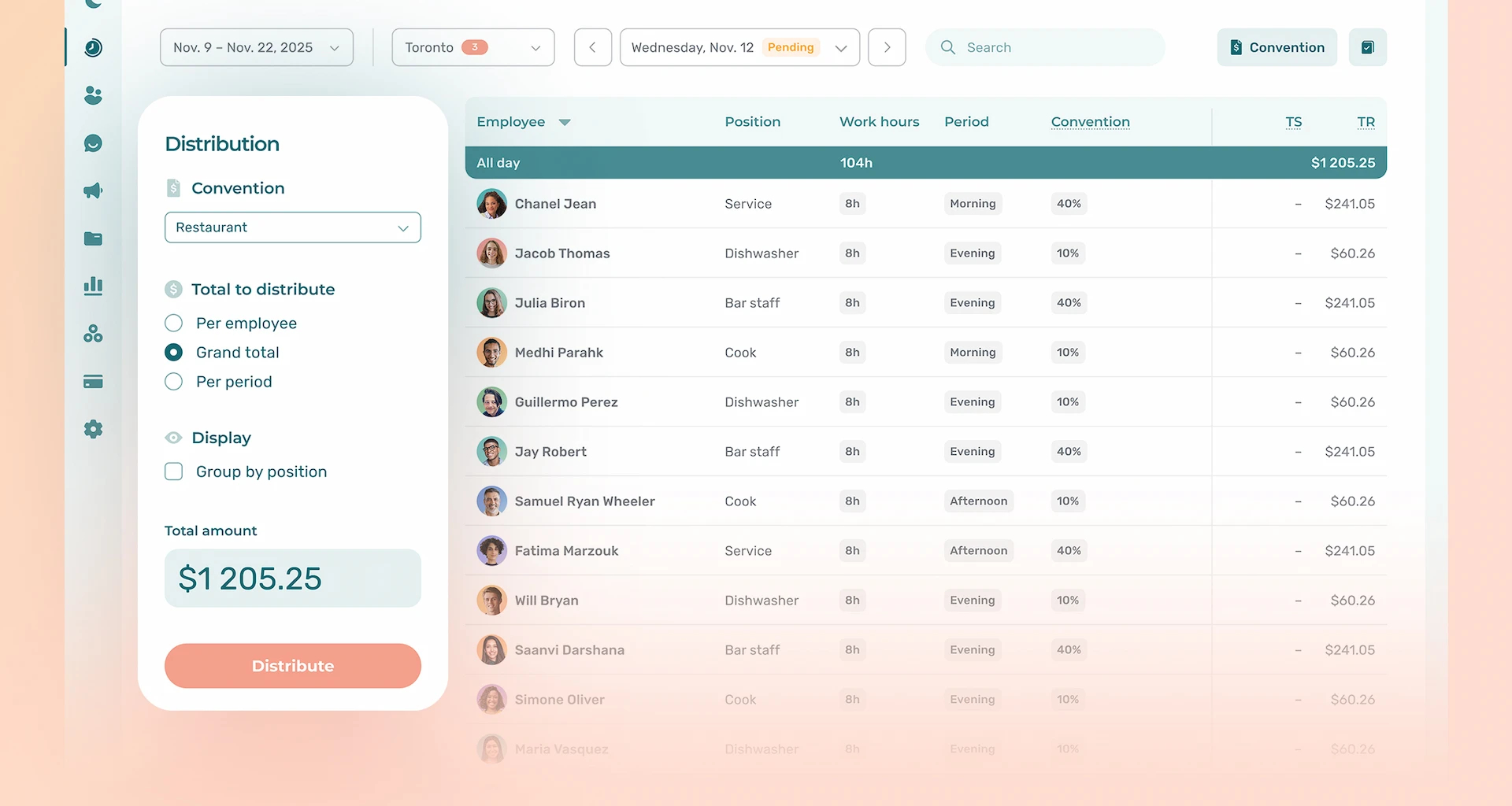
👉 Not ready to go fully automated? Try our free tip pooling calculator to test your split before you roll it out with your team.
Building a Tip Pooling System That Actually Works
Tip pooling laws in Canada are not complicated once you understand the core principle: tips belong to the employees who earn them, and any redistribution has to come from the team itself, not from management.
The legal framework varies by province, but the practical reality is the same everywhere. A tip pool without clear rules, transparent calculations, and genuine team buy-in creates friction. A well-run one does the opposite: it reduces tension between front of house and kitchen, makes payroll cleaner, and signals to your staff that you run a fair operation.
That last part matters more than most operators realize. In an industry where finding and keeping good people is a constant challenge, the way you handle something as visible as tips says a lot about how you run everything else.
Your cooks and your servers carry every service together. A tip pooling system done right acknowledges that.
Is tip pooling legal in Canada?
Yes, tip pooling is legal across Canada. However, the rules around employer involvement vary by province. In Quebec, a tip-sharing agreement must be initiated and approved by employees, with no employer interference. In Ontario, employers are prohibited from keeping tips but may participate in a pool if they perform the same work as tipped employees. Most other provinces permit tip pooling as long as it is employee-driven and transparently managed.
Can an employer take a share of the tip pool in Canada?
Generally, no. Canadian employment law in most provinces prohibits employers from retaining any portion of employee tips. The exception, in some provinces, is an owner or manager who actively performs the same hands-on work as tipped employees. When in doubt, check your province’s employment standards legislation.
What is the difference between tip pooling and tip sharing?
Tip sharing typically refers to an individual employee voluntarily giving a portion of their tips to a colleague (such as a server tipping out a busser). Tip pooling involves collecting all or a portion of tips from multiple employees into a shared pool, which is then redistributed according to a set formula, often based on hours worked or role.
Do tip pooling rules differ between provinces in Canada?
Yes, significantly.
- Quebec has the most prescriptive rules, requiring a formal employee-approved agreement with no employer interference.
- Ontario prohibits employer tip retention but allows employers to participate in a pool if they actively perform the same work as tipped employees.
- BC explicitly allows employers to require and establish a tip pool, though employers cannot take a share unless they do similar work to tipped staff.
- Alberta has no specific tip pooling legislation but prohibits employers from withholding tips.
Always verify the current rules in your province, as this area of employment law has been evolving across Canada.
How should tips be split between front of house and kitchen?
There is no legal formula. Common approaches include redistributing a fixed percentage of server sales to kitchen staff, splitting a shared nightly pool by hours worked, or applying a role-based weighting. Whatever method your team agrees on should be written down, applied consistently, and reviewed regularly as team composition and tip volumes change.