

Key takeaways
- Your safety first, then first aid: make sure the danger is gone before you step in. Then provide first aid and get the employee to care. Every province expects you to arrange transportation to medical care. In Quebec, the employer pays for it.
- Every province has a reporting deadline: three business days in Ontario, three days in British Columbia, 72 hours in Alberta. In Quebec, two days after the employee’s return or the 14th full day of absence.
- Who pays the day of the injury depends on your province: the employer pays it in Ontario, Alberta, and Quebec. British Columbia doesn’t require it.
- Serious injuries can’t wait: in all four of Canada’s largest provinces, you must report deaths and serious injuries to the health and safety regulator right away.
- Modified duties are your best return-to-work tool: they bring the employee back sooner, with tasks that match what they can safely do.
An employee just got hurt on shift and you’re the manager on duty? Here’s what to do after a workplace injury: the steps to take right away, how to report it in your province, and how to bring the employee back safely with modified duties.
In 2024, workers’ compensation boards across Canada accepted 267,199 lost-time injury claims, according to AWCBC data compiled in the 2026 Report on Work Fatality and Injury Rates in Canada.
Quebec led with 75,642 claims, followed by Ontario (71,781), British Columbia (54,993), and Alberta (28,286). That’s about 730 claims a day, and those numbers only count injuries serious enough to keep someone off work. So the question isn’t whether someone on your team will get injured at work. It’s whether you’ll know what to do when it happens.
📌 Note: This article is for information only and isn’t legal advice. Rules vary by province. For your specific situation, check with your provincial workers’ compensation board or a qualified professional.
What counts as a workplace injury in Canada
A workplace injury is an injury or illness that arises out of and in the course of employment. In plain terms, two things need to be true:
- It’s connected to the job: it happens while the employee is doing their work, or another task related to it (helping a coworker unload a truck, for example).
- It causes an injury or illness: something a health professional can diagnose and link to what happened at work.
A cut in the kitchen, a sprained ankle in the warehouse, or a back that seizes up while lifting a case are textbook examples. An injury that happens outside work falls under your regular sick leave rules instead.
💡 Ask employees to tell you about every incident, even without a visible injury. Pain that shows up the next morning is easier to deal with when the event was noted the same day. Not sure it’s work-related? Report it anyway: deciding is your board’s job, not yours.
What to do right after a workplace injury
On the day of the injury, here’s what to do, in order:
1. Make sure you’re safe. A running machine, a spill, an electrical cord? If there’s still a danger, stay back and call for help. A second injured person helps no one.
2. Secure the area. Shut off the equipment and move coworkers away. If the injury looks serious, leave the scene as is: an inspector may need to investigate. You can still act to save a life or prevent the situation from getting worse.
3. Give first aid. Let your trained first aider handle it, with the first aid kit. In an emergency, call 911.
4. Arrange transportation. If the employee needs medical care, get them to a hospital or clinic. Every province expects you to arrange it. In Quebec, the employer pays for it. Don’t let an injured employee drive themselves.
5. Report a serious injury right away. Call your province’s health and safety regulator.
- Ontario: Ministry of Labour, Immigration, Training and Skills Development, at 1-877-202-0008 (24/7)
- British Columbia: WorkSafeBC’s Prevention Information Line, at 1-888-621-7233
- Alberta: Alberta OHS Contact Centre, at 1-866-415-8690
- Quebec: CNESST, at 1-844-838-0808
6. Pay the day, if your province requires it. In Ontario, Alberta, and Quebec, if the employee can’t finish their shift, you still pay them for the full day, even if they left after an hour. British Columbia’s law doesn’t require it.
Document what happened and why
The first aid record keeps track of every injury, even a minor one, and the care provided. A good record includes:
- The employee’s name
- The exact time and place of the incident
- A description of what happened and of the injury
- A summary of the first aid given
Then add the corrective measures you took to make sure it doesn’t happen again. Log near misses too, like a slip that almost ended in a fall. A water leak or a cracked floor tile flagged today is one less fall next month.
The first aid record documents the event. An accident report helps you understand it: witnesses, likely causes, photos, and corrective measures. Ideally, fill it out within 24 hours, while memories are fresh.
📄 Two free templates to get started:
- A workplace accident report form, to document an event that caused an injury
- A workplace incident report template, to log near misses before they turn into injuries
How workplace injury reporting works across Canada
Each province has its own workers’ compensation board, with its own forms, deadlines, and pay rules. Here’s how the four largest compare.
| Province | Board | Employer form | Deadline | Pay for the day of injury | Wage-loss benefits |
|---|---|---|---|---|---|
| Ontario | WSIB | Form 7 (Employer’s Report of Injury/Disease) | 3 business days after learning of the injury | Paid by the employer | 85% of net average earnings, from the next day |
| British Columbia | WorkSafeBC | Form 7 (Employer’s Report of Injury or Occupational Disease) | 3 days | Not required by law | About 90% of net earnings |
| Alberta | WCB-Alberta | Employer Report of Injury | 72 hours after becoming aware of the injury | Paid by the employer | 90% of net earnings |
| Quebec | CNESST | Avis de l’employeur et demande de remboursement (ADR) | 2 days after the employee’s return or the 14th full day of absence | Paid by the employer, who then advances 90% of net salary for 14 days (reimbursed) | 90% of net income, from day 15 |
In most provinces, you report to the board when the employee needs care beyond first aid or misses work after the day of the injury. Rules change, so check with your board before acting on a specific case.

Workplace injury in Ontario: the essentials
In Ontario, two separate systems can come into play after a workplace injury:
- The WSIB handles the claim: benefits, health care, and return to work.
- The Ministry of Labour, Immigration, Training and Skills Development enforces the Occupational Health and Safety Act (OHSA).
Some injuries must be reported to both, so there are three deadlines to know:
| Situation | Deadline | Who to notify |
|---|---|---|
| Death or critical injury | Immediately by phone, then a written report within 48 hours | The Ministry, your health and safety committee or representative, and the union, if any |
| Employee can’t do their usual work or needs medical attention | Written notice within 4 days | Your committee or representative, and the union |
| Injury reportable to the WSIB | Form 7 within 3 business days | The WSIB, with a copy to the employee |
When Form 7 is required
File it if the employee needs health care beyond first aid, misses work, earns less than their regular pay, or needs modified work for more than seven calendar days. If it’s first aid only and none of these apply, keep your first aid record and you’re done. Late or incomplete reports, or discouraging an employee from reporting, can lead to penalties.
What counts as a critical injury
A critical injury is one that puts life at risk, causes unconsciousness or substantial blood loss, breaks a leg or an arm, amputates a leg, arm, hand, or foot, burns a major part of the body, or causes the loss of sight in an eye. One finger or toe doesn’t count, but more than one does.
Modified duties: bringing the employee back safely
Modified duties let an injured employee come back in an adjusted role while they recover. They keep the employee connected to the team, and their know-how on your floor. Every province encourages them, under different names: modified work (Ontario and Alberta), light duties (British Columbia), or temporary assignment (Quebec).
The principles are the same everywhere:
- Base them on the employee’s restrictions. The employee’s health professional tells you what they can and can’t do. In Ontario, the WSIB’s Functional Abilities Form does exactly that, by describing what the employee can and can’t do.
- Offer real work. Fewer tasks or a lighter pace in the same job, another existing job, or a set of tasks your team actually needs done. The WSIB’s list of modified work suggestions is useful wherever you are.
- Put it in writing. Tasks, hours, pay, and expected duration.
- Stay in touch. With the employee and with your board, as recovery progresses.
For example, a line cook who cut their hand and can’t handle a knife for three weeks could do inventory, receive deliveries, and label products instead. They’re back on shift after a few days instead of three weeks, and the kitchen keeps someone who knows how things are done.
Both sides have obligations. If you don’t cooperate, you can be penalized: in Ontario, WSIB penalties start at 50% of the employee’s wage-loss benefits and can reach 100% for up to 12 months. If the employee refuses suitable work without a valid reason, their benefits can be reduced or suspended.
💡 A physical injury can also leave fear behind. An employee hurt on a meat slicer may not want to go near it again. Plan a conversation before their first shift back, not just a return date. More on this in our article on psychosocial factors in the workplace.
How long you must hold the job
Everywhere in Canada, human rights laws treat a lasting workplace injury as a disability: you must accommodate the employee to the point of undue hardship, whatever the size of your business.
Two provinces add a set period:
- Ontario: if you have 20 or more employees and the employee worked for you continuously for at least a year before the injury, you must offer them their job or suitable work until the earliest of these dates: two years after the injury, one year after they’re medically able to do their job again, or their 65th birthday.
- Quebec: the employee can return to their job within one year if the workplace has 20 employees or fewer, and within two years if it has 21 or more.
Covering shifts and planning the return in the schedule
A workplace injury creates two scheduling problems: a gap to fill tonight, and a return to plan over several weeks.
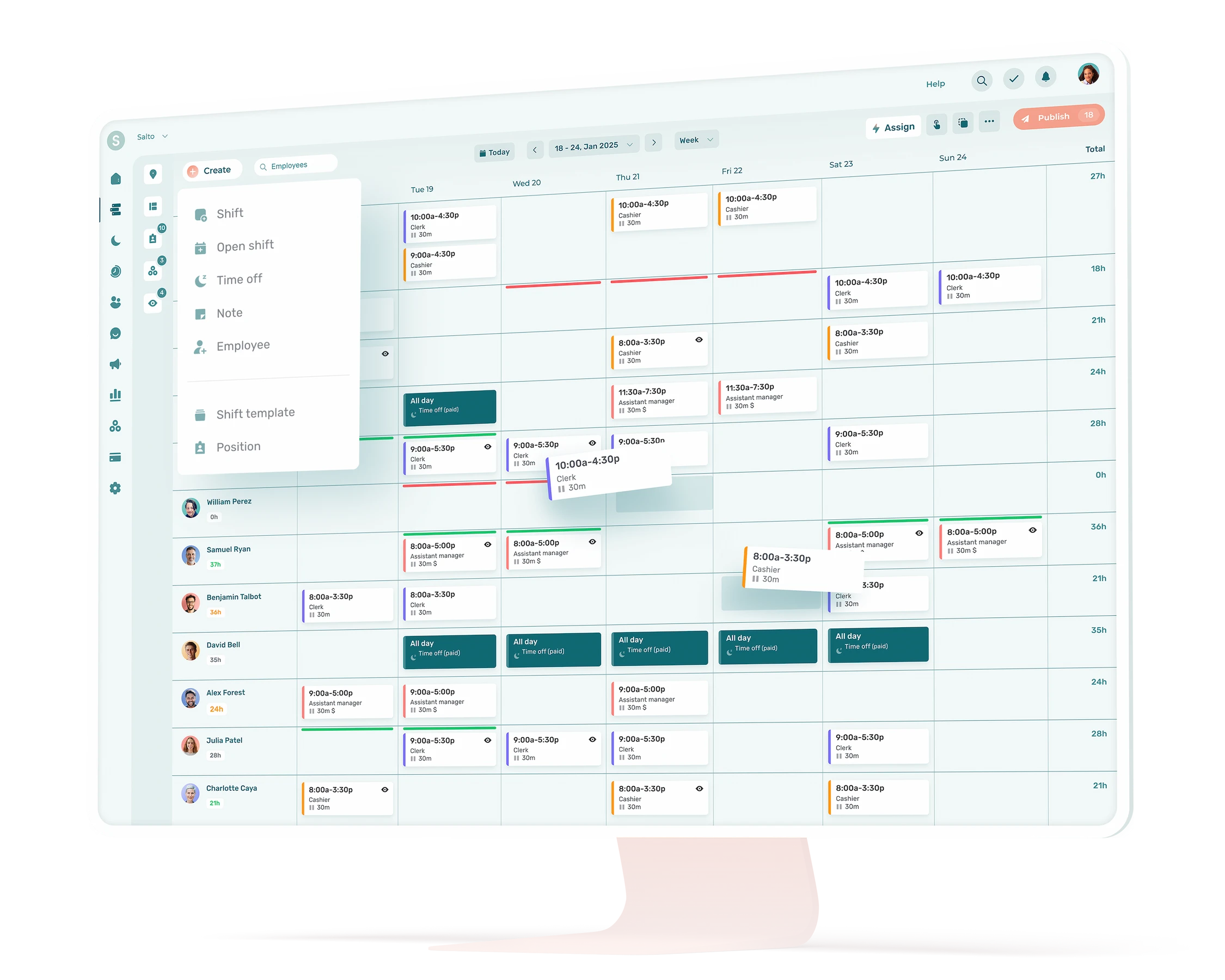
- Fill the gap. The injured employee’s shifts become open shifts. Post them so available coworkers can claim them, instead of calling your whole staff list. Employee scheduling software does it in a few clicks.
- Pass on the information. Note the incident in your end-of-shift report, so the next team knows why someone’s missing and which area to watch.
- Schedule within the restrictions. If the doctor approved four hours an evening, the schedule should show exactly that. Assign the right position, or someone will eventually ask the employee to “just help out” at the station where they got hurt.
- Track the hours actually worked. Fewer hours affect the employee’s benefits, and your board will ask for accurate earnings. Precise clock-in data saves you from rebuilding hours from memory.
- Keep one confidential file. First aid record, board report, medical notes, and follow-ups in one place, like online employee records.
- Tell the team, without medical details. A short message in your team communication app is enough: who’s coming back, to which position, and with what restrictions.
The best time to prepare is before
No one reads a guide on workplace injuries while an employee is waiting for first aid. Take ten minutes this week: check where the first aid kit and records are, who’s trained in first aid on each shift, and whether your managers know your province’s reporting deadline. When an injury happens, you won’t have to look for anything. You’ll know what to do, and so will your team.
What should an employer do when an employee is injured at work?
Make sure there’s no more danger, then give first aid and get the employee to a clinic or hospital if needed. Report any serious injury to your province’s health and safety regulator right away. Then fill out the first aid record and file your report with your workers’ compensation board before the deadline.
How long do employers have to report a workplace injury in Canada?
It depends on the province:
- Ontario: 3 business days (Form 7)
- British Columbia: 3 days (Form 7)
- Alberta: 72 hours (Employer Report of Injury)
- Quebec: the ADR is due within 2 days of the employee’s return or of the 14th full day of absence (LATMP, s. 269).
Serious injuries must be reported to the health and safety regulator immediately, in every province.
How do you report a workplace injury in Ontario?
File Form 7 with the WSIB within 3 business days if the employee needs health care beyond first aid, misses work, earns less than their regular pay, or needs modified work for more than seven calendar days. Give the employee a copy. For a death or critical injury, call the Ministry of Labour immediately, then send a written report within 48 hours.
Who pays when an employee is injured at work?
In Ontario, Alberta, and Quebec, the employer pays the full day of the injury. British Columbia doesn’t require it. After that, the provincial board pays wage-loss benefits. Quebec is the exception: the employer advances 90% of net salary for the first 14 days, and the CNESST reimburses it.
What are modified duties?
Modified duties are temporary changes to an injured employee’s job, like fewer tasks, a lighter pace, or a different role, so they can work safely while they recover. They’re based on the restrictions set by the employee’s health professional. Every province encourages them, under different names.
What’s the difference between a workplace injury and regular sick leave?
A workplace injury comes from an event at work and falls under your provincial workers’ compensation board. Regular sick leave has nothing to do with work. It falls under your province’s employment standards and, depending on the case, is paid through group insurance or Employment Insurance sickness benefits.