


Key takeaways
- There is no single Canadian rule. Each province and territory sets its own statutory holiday pay formula, and federally regulated employers follow a separate one under the Canada Labour Code.
- The models cluster into three families. Once you see the pattern, thirteen rules become three: a fixed-divisor method, an average-over-days-worked method, and a regular-day’s-pay method gated by stricter eligibility.
- What counts as “wages” varies. Ontario folds vacation pay into the calculation. Quebec doesn’t. Small differences, real dollars.
- Part-timers usually still qualify. Eligibility rules differ by province, but excluding part-time or irregular staff by default is one of the most common and costly mistakes.
A stat holiday rolls around, and you’re pretty sure you know what to pay your team. Pretty sure. But is it a regular day’s pay? An average of the last few weeks? Does that part-timer who only works weekends even qualify?
If you’ve ever second-guessed the math on statutory holiday pay, it’s not because you’re doing it wrong. The rule genuinely isn’t obvious, and most provinces calculate it in a way that isn’t quite what you’d expect. And when it’s your business, an honest mistake either comes out of your pocket or shows up as an underpaid employee.
This guide walks through how stat holiday pay actually works, so you can run the numbers for your team with confidence and stop hoping you got it right. It’s written for the owner or manager who signs the paycheques, not for a payroll textbook.
What statutory holiday pay actually is
Statutory holiday pay is the amount you owe an employee who qualifies for a public holiday, whether they have the day off or work it. It exists so that a holiday doesn’t cost workers a day’s income, and it applies whether someone is full-time, part-time, or on an irregular schedule.
Two separate things often get bundled together, and it helps to keep them apart. The first is the holiday pay itself: what an eligible employee receives for the day. The second is premium pay: the extra amount owed on top when the employee actually works the holiday. Most provinces treat these as two separate things, which is why someone who works a statutory holiday can end up with noticeably more than someone who stays home.
The three ways Canada calculates stat holiday pay

The fixed-divisor method: divide by 20 (or take 5%)
Add up what the employee earned in the four weeks before the holiday and divide by 20. Some provinces call it 5% instead, but you land on the exact same number. This is the most common approach, used in Quebec, the federal sector, Ontario, Manitoba, Saskatchewan, and Prince Edward Island.
The math is quick once you have the wages. Someone earning $800 a week made $3,200 over those four weeks, so their holiday pay is $3,200 divided by 20, which is $160.
A few local things to know. In Quebec, staff paid on commission are figured over the twelve weeks before instead of four, which trips up a lot of Quebec payroll. In Ontario, you add vacation pay to those four weeks before you divide, so leave it out and you’ll pay too little. Manitoba and Saskatchewan drop to 4% for construction.
💡 Quebec’s full set of rules lives in our guide to public holidays in Quebec.
The average-day’s-pay method: divide by days actually worked
For this method, instead of always dividing by 20, you take what they earned recently and divide by the number of days they actually worked. That gives you their true average day. British Columbia, Alberta, the Northwest Territories, and Yukon do it this way.
Here’s the part that surprises people. Say a part-timer earned $1,500 and worked 12 days in the period. Their average day is: $1,500 divided by 12, which is $125. The same $1,500 through a divide-by-20 would give only $75. The fewer days someone works, the bigger their average day, which is the opposite of what most people expect.
Each province sets its own rules for the window and who qualifies. B.C. looks at the 30 days before the holiday, and the person needs 30 days on the job plus pay on at least 15 of those days. Alberta has a quirk called the “5 of 9” rule: the holiday only counts as a paid day if they worked that same weekday (say, Mondays) in at least 5 of the 9 weeks before. Yukon is the odd one out, for irregular hours it uses 10% of the pay from the two weeks before.
The regular-day’s-pay method: the eligibility is the real test
Here the math barely matters: it’s just a normal day’s pay. What’s different in these places is that fewer people qualify, because the rules to earn it are stricter. Nova Scotia, New Brunswick, Newfoundland and Labrador, and Nunavut work this way.
The calculation is exactly what it sounds like. Someone who normally earns $140 for a shift gets $140 for the holiday. Nothing to divide. So your real job here isn’t the math, it’s knowing who qualifies, because that’s what decides whether they get paid at all.
And qualifying is harder. Nova Scotia wants the person to have been paid for 15 of the 30 days before, and to work their shifts on either side of the holiday. New Brunswick asks for 90 days on the job. Newfoundland and Labrador works a bit differently: instead of a flat normal day, it averages the pay over the three weeks before. It asks for 30 days on the job plus the shifts around the holiday, and it stands out because anyone who works the holiday earns double, one of the highest rates in the country. Nunavut wants 30 days of work in the past year plus the shifts around the holiday.
The table below places every jurisdiction.
| Jurisdiction | Model | The specifics |
|---|---|---|
| Alberta | Average day’s pay | Their pay over the last 4 weeks, divided by the days they worked. The day only counts if they usually work that weekday. |
| British Columbia | Average day’s pay | Their pay over the last 30 days, divided by the days they worked. They need 30 days on the job and pay on at least 15 of those days. |
| Manitoba | Fixed divisor (5%) | 5% of their pay over the last 4 weeks. Construction: 4%. |
| New Brunswick | Regular day’s pay | A normal day’s pay. They need 90 days on the job first. |
| Newfoundland & Labrador | Regular day’s pay (avg) | Their average day’s pay over the last 3 weeks. They need 30 days on the job. If they work the holiday, they earn double. |
| Northwest Territories | Average day’s pay | Their average day’s pay from recent weeks. They need 30 days on the job and to work their shifts around the holiday. |
| Nunavut | Regular day’s pay | A normal day’s pay. They need to have worked 30 days in the past year and their shifts around the holiday. |
| Nova Scotia | Regular day’s pay | A normal day’s pay. They need pay on 15 of the 30 days before, and to work their shifts around the holiday. |
| Ontario | Fixed divisor | Their pay plus vacation pay over the last 4 weeks, divided by 20. Don’t forget the vacation pay. |
| Prince Edward Island | Fixed divisor (5%) | 5% of their regular pay over the last 4 weeks. |
| Quebec | Fixed divisor | 1/20 of their pay over the last 4 weeks. Commission staff: 1/60 over 12 weeks. |
| Saskatchewan | Fixed divisor (5%) | 5% of their pay over the last 4 weeks. Easy to qualify. Construction: 4%. |
| Yukon | Average day’s pay | Their regular day’s pay, or for irregular hours, 10% of their pay over the last 2 weeks. |
The spread is real. Take a part-time barista who earned $1,800 over the four weeks before the holiday and worked 15 days in that window.
- If they work in Ontario, they receive $93.60: the $1,800 plus $72 in vacation pay, divided by 20.
- In B.C., average-day they get $120: the $1,800 divided by the 15 days actually worked.
Same person, same earnings, same holiday, with a $26 gap.
The situations that actually trip managers up
Most of the real mistakes on holiday pay happen in the cases the basic formula doesn’t spell out, and those are exactly the ones that come up with shift teams.
The holiday lands on a day the employee doesn’t normally work. In most provinces you still owe them something, even if the holiday falls on their day off. Say someone only works Fridays and Saturdays and the holiday is a Monday. It’s easy to think they get nothing, since they’d never work a Monday anyway. But they earned wages over the past few weeks, so they still get a fair share for the day.
Part-time and casual staff. Leaving them out by reflex is a common and costly mistake. Part-timers usually qualify, as long as they meet their province’s rules. The formula already gives them a smaller amount to match their fewer hours, so you don’t need to leave anyone out to keep it fair. A part-timer who earned $600 gets a smaller holiday amount than a full-timer who earned $2,400. That’s the formula working as intended, not a reason to skip them.
Someone works the holiday. In most provinces they get two separate amounts: their holiday pay, plus a higher rate on the hours they actually work that day. Miss the second one and you’ve underpaid. Take someone at $20 an hour on an 8-hour shift: those hours are normally worth $160, but at time-and-a-half they’re worth $240, so the extra $80 is the premium. In Newfoundland and Labrador, where the holiday rate is double time, that premium jumps to $160. Apply the wrong rate across a whole team and it adds up fast.
The overnight shift that straddles midnight. For shift teams this one is genuinely tricky. Say someone clocks in at 8 p.m. the night before the holiday and clocks out at 4 a.m. on the holiday itself. Only those 4 hours after midnight count as holiday hours, and several provinces only pay the premium on the hours actually worked on the holiday. Get the split wrong and you either overpay the evening or miss the premium on the early morning. Clean time data is what keeps a shift like this landing on the right day.
An employee on vacation during the holiday. A holiday that falls during a paid vacation still has to be paid or banked as its own day. It doesn’t just disappear into the vacation. In practice, they take their vacation as planned, and the holiday gets added on top or moved to another day, not quietly swallowed.
Why this gets harder the more locations you run

A single-location restaurant in Jasper has one set of rules to learn. A retail group with stores in three provinces has three calculation models running at once, plus different eligibility tests and premium rules. The math itself isn’t hard. Keeping multiple possible versions of it straight, across dozens of employees with irregular hours, is where it breaks down.
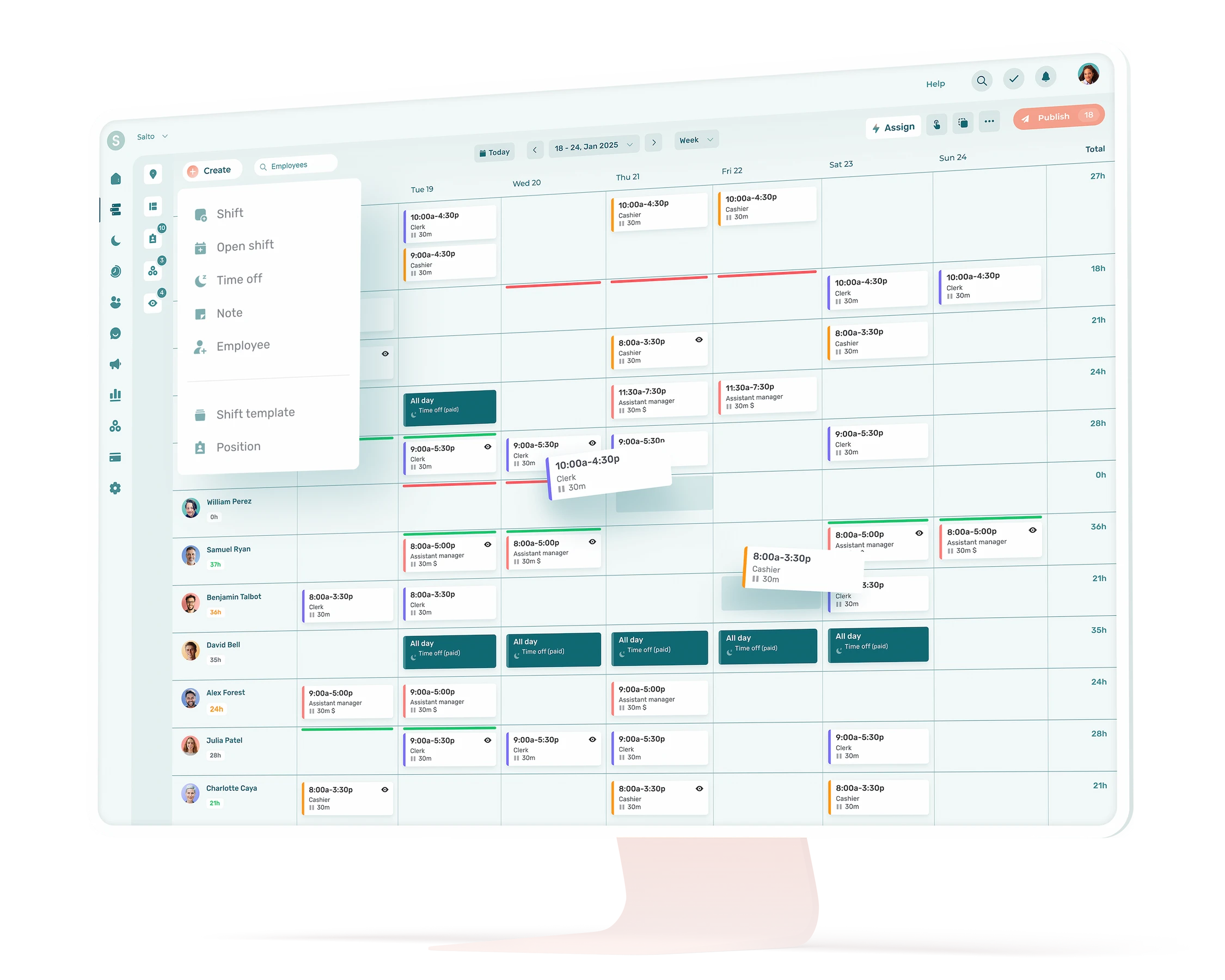
This is where clean time data does the heavy lifting. If the hours feeding your payroll are accurate and tied to the right location, the holiday calculation has something solid to run on. Time and attendance software that tracks hours by location and feeds them straight into your pay period takes most of the manual cross-province guesswork off your plate. It won’t make the rules simpler, but it stops the same error from repeating across every holiday and every location.
Want to know the dates of each holiday for the current year? The province-by-province detailed list lives in our statutory holidays across Canada reference.
One formula to learn, not a payroll guessing game
You only ever have to learn the model that applies to you, and then it’s the same every holiday. Keep your hours accurate and the calculation runs on solid ground instead of a best guess. The long weekend shouldn’t cost you a second-guess every time it comes around.
Want to stop recalculating holiday pay by hand every long weekend? Try Agendrix free for up to 21 days and let the schedule feed payroll for you.
What is stat holiday pay?
Stat holiday pay is the amount an employer owes an eligible employee for a public holiday, whether the employee takes the day off, is not scheduled or works it. The amount is set by a formula that differs by province, and by the Canada Labour Code for federally regulated employers.
Do you get paid for stat holidays if you don't work?
In most cases, yes. Eligible employees are generally entitled to statutory holiday pay even when they don’t work the day, including when the holiday falls on a day they wouldn’t normally work. The exact amount depends on your province’s calculation method.
How is stat holiday pay calculated?
It comes down to one of three models. Some provinces use a fixed divisor (1/20 of recent wages, or the equivalent 5%). Others use an average day’s pay (recent wages divided by days actually worked). A few simply pay a regular day’s wage but apply stricter eligibility tests. Your province decides which one applies.
What's the difference between stat holiday pay in Ontario and B.C.?
Ontario uses a fixed divisor: regular wages plus vacation pay over the previous four weeks, divided by 20. B.C. calculates an average day’s pay by dividing wages over the previous 30 calendar days by the number of days actually worked. For an employee with irregular hours, the two methods can produce noticeably different amounts.
Do part-time employees get stat holiday pay?
Usually, yes, as long as they meet their province’s eligibility. The formula already gives them a smaller amount to match their fewer hours, so part-timers and casual staff usually qualify instead of being left out.
What happens if an employee works on a statutory holiday?
In most provinces the employee is owed their holiday pay plus premium pay for the hours worked, often at 1.5 times the regular rate, or a substitute day off with pay by agreement. Newfoundland and Labrador is a notable exception, with a 2x premium. In almost every province, the holiday pay and the premium are two separate amounts.
Which employers follow the federal rules instead of provincial ones?
Federally regulated businesses, such as banks, telecommunications companies, and interprovincial transport, follow the Canada Labour Code rather than provincial employment standards. The Code sets its own holiday list and its own calculation method.