Key takeaways
- Deductions follow the paycheque, not the year: CPP, EI and income tax are calculated on each pay on its own, so a big week is taxed like a big year.
- A short week can mean zero CPP: below the pay-period exemption ($67.30 for a weekly pay in 2026), no CPP or QPP comes off, but EI still does.
- Two jobs, two sets of deductions: each employer deducts CPP and EI as if it were the only one. If combined pay goes over the yearly maximums, the employee gets the excess back at tax time. The employers don’t.
- Age changes the math: CPP and QPP start the month after an employee’s 18th birthday. EI and income tax apply at any age.
- The remittance clock follows payday: most employers send deductions by the 15th of the month after the month they paid employees.
Employer payroll deductions look simple on paper. Then an employee works 12 hours one week and 43 the next, and a perfectly correct paycheque starts to look wrong.
Ask a pharmacy or restaurant manager about payroll questions from staff and you’ll hear the same one: “Why did they take so much off my cheque this week?” Most of the time, payroll didn’t make a mistake. The employee’s hours changed, and the deductions changed with them.
Hours rarely stay put in shift work, and payroll deductions react to every swing.
About 2 in 5 employees (41.9%) saw their hours change by 5 hours or more from one week to the next: 20 hours one week, 25 or 15 the next. (Agendrix data, September 2026)
How we measured it: we compared the clocked hours of nearly 115,000 employees at over 4,500 Canadian businesses using Agendrix, over two regular workweeks in 2026 (no statutory holiday). Only employees who worked both weeks were counted.
This guide explains why, situation by situation, with 2026 rates that apply in every province, plus Quebec’s own (QPP and QPIP). For the full setup (registration, rates, remitter types, T4 slips), see our step-by-step guide to running payroll in Canada.
Why employer payroll deductions follow the paycheque, not the year
Employer payroll deductions, also called source deductions, are the Canada Pension Plan (CPP) contributions, Employment Insurance (EI) premiums and income tax an employer withholds from each paycheque and sends to the Canada Revenue Agency (CRA). In Quebec, the Quebec Pension Plan (QPP) replaces CPP and the Quebec Parental Insurance Plan (QPIP) is added on top.
The catch: the yearly rules are applied one paycheque at a time. The CPP exemption is split across pay periods, and tax is withheld on what each pay looks like on its own. Nobody looks at the whole year until the employee files a tax return.
For a salaried employee, that makes no difference. Every pay is the same. For an employee whose hours move every week, each paycheque is a different snapshot, and the deductions move with it.
1 employee in 8 (12.3%) saw their hours double or drop by half from one week to the next: 15 hours one week, 30 the next, or the reverse. (Agendrix data, sample of nearly 115,000 employees, September 2026)
That’s the whole framework: deductions follow the paycheque, not the year. Once you see it that way, the seven situations below stop being surprises.
Here’s what that looks like in each situation, and what you can tell an employee who asks.
| Situation | What happens on the paycheque | What to tell the employee |
|---|---|---|
| Big week | Income tax jumps more than the pay does | “The extra tax isn’t lost. If too much came off over the year, you get it back when you file.” |
| Short week | Under $67.30 on a weekly pay: no CPP or QPP, but EI still comes off | “No CPP this week is normal. Your pay was under the weekly exemption.” |
| Two jobs | Each employer deducts as if it were the only one | “Each job deducts on its own. If you go over the yearly maximums, the excess comes back when you file your taxes.” |
| Under 18, over 70 (73 in Quebec) | No CPP or QPP | “No pension contributions at your age, but EI and income tax still apply.” |
| Tips | Controlled tips are deducted, direct tips aren’t | “Tips we collect and share out are on your pay stub. Tips handed to you directly aren’t, except in Quebec restaurants and bars, where you declare them to us.” |
| Missed hours paid later | Added to the next pay: deducted like regular pay. Paid on their own: taxed like a bonus | “Those are your missing hours. They show as their own line on your pay stub.” |
| Remittance | The deadline follows the pay date, not the dates worked | Nothing to explain, it’s on the employer side |
The big week: overtime and the holiday rush
A 46-hour week during the holiday rush produces a bigger paycheque, and income tax jumps more than the pay does. The payroll tables don’t know it’s a one-off. They withhold tax as if the employee earned that amount every pay period of the year, which pushes part of it into a higher tax bracket.
The employee isn’t losing that money. If too much tax came off over the year, the difference comes back when they file their return. But the paycheque still looks smaller than expected.
Bonuses work differently. When you pay a bonus or another irregular amount separately from regular pay, the CRA’s bonus method applies: payroll works out the tax on the bonus as extra income for the year, instead of treating it like a regular paycheque.
💡 Big weeks are easier to explain when overtime is planned. Our tips on reducing employee overtime help keep those spikes to a minimum, and banked time lets employees take some of those hours as time off instead of pay, where your province allows it.
The short week: the CPP exemption and why EI still comes off
The CPP basic exemption is $3,500 a year. Payroll splits it by pay period: $67.30 for a weekly pay and $134.61 for a pay every two weeks, according to the CRA. CPP only applies to the part of the pay above that amount.
Take Leah, a college student in Red Deer, Alberta, who works one 3-hour shift in a week at $17.50 an hour. She earns $52.50, which is under the $67.30 weekly exemption, so no CPP comes off her pay. EI still does, from the first dollar: about $0.86. In Quebec, it works the same way with QPP (see example below).
And if Leah earns $2,000 or less for the whole year, from all her jobs, she gets all her EI premiums back when she files her tax return.
The second job: when employees overpay CPP and EI
Many shift workers hold two jobs. In August 2025, 5.4% of workers in Canada held more than one job, according to Statistics Canada.
Each employer deducts CPP and EI without taking into account what the other employer withheld. Each one also applies the full CPP exemption. If both jobs add up past the yearly maximums ($74,600 of pensionable earnings for CPP and $68,900 of insurable earnings for EI in 2026), the employee overpays, and the CRA refunds the excess when they file their tax return. Below those amounts, there’s nothing to refund.
The employer’s side is different. The CRA states there is no provision in the Canada Pension Plan to refund or credit employers for their contributions in that situation. Each employer’s CPP cost stays as paid. That’s normal, not a mistake to fix.
Two employers never compare notes on CPP or EI. If combined pay passes the yearly maximums, the employee gets the excess back at tax time. The employers don’t.
Under 18 or over 70 (73 in Quebec): who skips CPP or QPP
Age changes who pays CPP or QPP, which matters a lot in retail and restaurants. The rules are the same in every province except Quebec, where QPP keeps applying until the year an employee turns 73, instead of 70.
| Situation | CPP (outside Quebec) | QPP (Quebec) | EI | Income tax |
|---|---|---|---|---|
| Under 18 | No | No | Yes | Yes |
| Turns 18 | Starts on the first pay dated in the month after the 18th birthday | Starts in the first month after the month the employee turns 18 | Yes | Yes |
| 65 or older, receiving a retirement pension | Can elect to stop with form CPT30 | 65 to under 73: can elect to stop | Yes | Yes |
| Turns 70 | Stops after the last pay dated in the month the employee turns 70 | Continues until the year the employee turns 73 | Yes | Yes |
EI has no age limit. In Quebec, Revenu Québec confirms that an employee’s age doesn’t affect income tax withholding, QPIP premiums or the employer’s Health Services Fund (FSS) contribution.
Tips: when they’re deducted on the pay stub, and when they’re not
The CRA sorts tips into two kinds, and the deductions depend entirely on which one you have.
- Controlled tips are tips the employer collects and shares out with its own formula, such as a tip pool split by the manager. They’re part of the employee’s pay, so CPP, EI and income tax come off at source.
- Direct tips go straight from customer to employee, with no employer involvement. Card tips paid back to the employee in cash at the end of the shift count as direct tips too. They aren’t subject to CPP, EI or income tax deductions at source. Employees can choose to contribute to CPP on them with form CPT20.
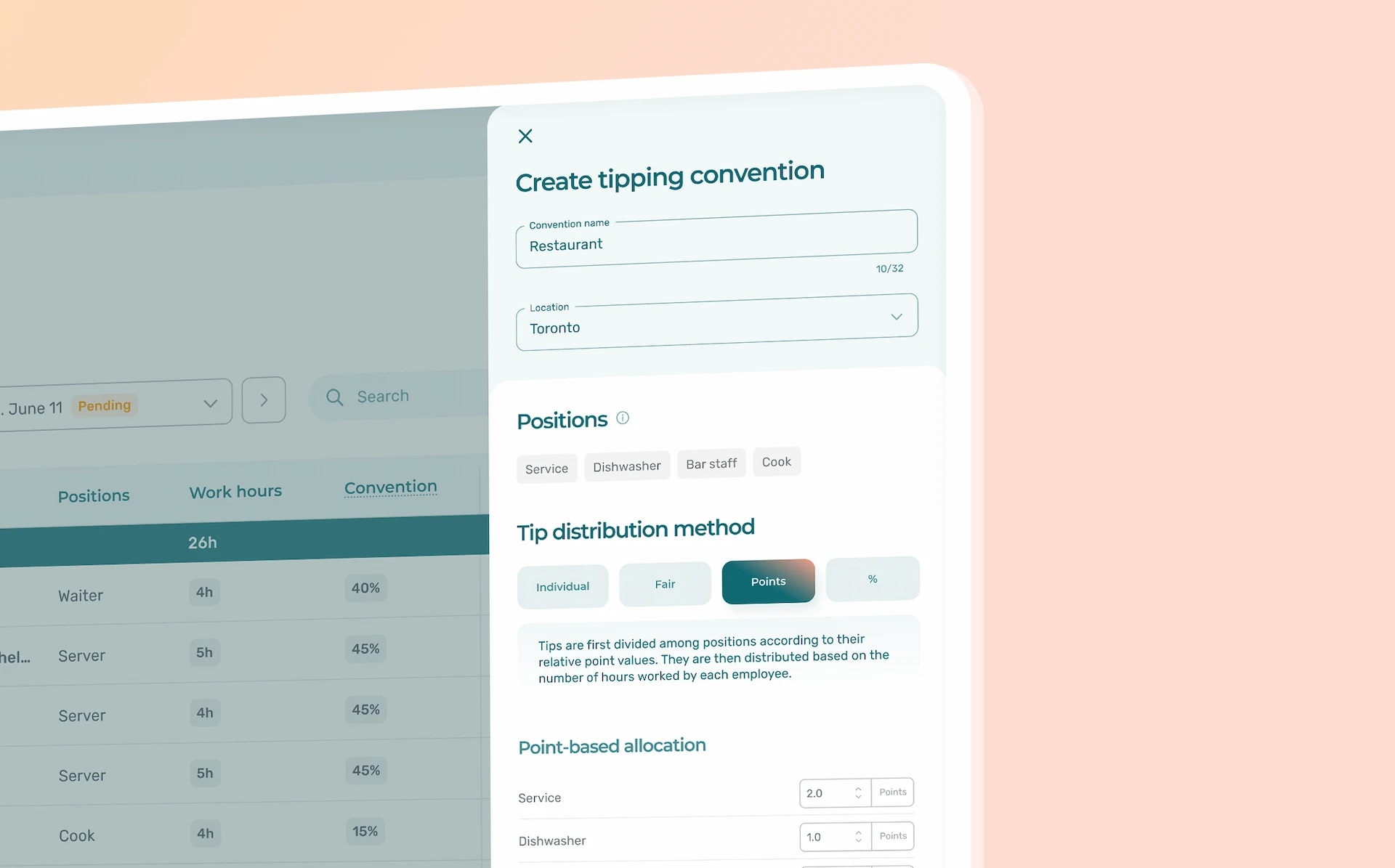
Quebec has its own rules for declared and allocated tips. Our guide on whether tips are taxable in Canada covers the details by province. If you pool tips, tip pooling software keeps the amounts tied to each employee’s hours.
Fixing hours after payroll has run
A missed punch, a forgotten shift swap, a late overtime approval: corrections happen. How you pay them changes the deductions.
- Added to the next regular paycheque, the missing amount is treated like regular pay for that period.
- Paid separately as its own payment, it’s treated as an irregular payment, so income tax and CPP are calculated with the CRA’s bonus method.
Either way, it’s reported on the T4 (and the RL-1 slip in Quebec) for the year the employee receives it. Show the correction as its own line on the pay stub so the employee can see what happened.
The cleaner fix is upstream. When employees clock in and out, online timesheet software catches missed punches before payroll closes, not after.
Remittances: the clock starts on payday
Remittance deadlines follow the date you paid employees, not the weeks they worked. Most employers send their deductions once a month (the CRA calls them regular remitters). They have until the 15th of the month after the month they paid employees. Very small employers can qualify to remit every three months instead.
Say an employee works on September 28 but gets paid on October 2. Those deductions count with October’s pay, not September’s.
Quebec employers remit twice: QPP, QPIP and Quebec income tax to Revenu Québec, and EI and federal income tax to the CRA. Late payments are expensive on both sides.
| Days late | CRA penalty | Revenu Québec penalty |
|---|---|---|
| 1 to 3 | 3% | 7% |
| 4 to 5 | 5% | 7% |
| 6 to 7 | 7% | 7% |
| 8 to 14 | 10% | 11% |
| More than 14 | 10% | 15% |
The CRA applies its penalty only to the part of the late amount above $500, unless the failure was knowing or grossly negligent. Interest is added on top in both cases.

Two employees, four weeks: what comes off each paycheque
Here’s the framework on two real schedules. Both employees are paid weekly, at 2026 rates. Simran’s table includes an income tax estimate with basic tax credits. Owen’s leaves it out to keep the Quebec example simple.
Simran, pharmacy assistant in Kingston, Ontario ($19/hour, overtime after 44 hours)
| Week | Hours | Gross pay | CPP (5.95%) | EI (1.63%) | CPP as % of gross | Income tax (estimate) |
|---|---|---|---|---|---|---|
| 1 | 9 | $171.00 | $6.17 | $2.79 | 3.6% | $0 |
| 2 | 24 | $456.00 | $23.13 | $7.43 | 5.1% | about $21 |
| 3 | 36 | $684.00 | $36.69 | $11.15 | 5.4% | about $66 |
| 4 | 47 (3 overtime) | $921.50 | $50.82 | $15.02 | 5.5% | about $111 |
How to read a line (week 2): CPP = ($456 − $67.30 exemption) × 5.95% = $23.13. EI = $456 × 1.63% = $7.43. Income tax is an estimate from the CRA’s 2026 payroll formulas for Ontario, with basic tax credits. The pharmacy also pays its own share: the same $23.13 of CPP, plus $10.40 of EI (1.4 × $7.43).
Look at the “CPP as % of gross” column: CPP takes 3.6% of Simran’s pay in her short week and 5.5% in her long one. Yet the CPP rate itself is always 5.95%. The difference comes from the $67.30 exemption: no CPP is charged on that first $67.30, and on a small paycheque, that’s a much bigger part of the pay.
Income tax jumps even more: her pay roughly doubles from week 2 to week 4, but her income tax goes up about five times: from about $21 to about $111. Her 9-hour week has no income tax at all.
Owen, line cook in Gatineau, Quebec ($18/hour, overtime after 40 hours)
| Week | Hours | Gross pay | QPP (6.30%) | QPIP (0.430%) | EI (1.30%) |
|---|---|---|---|---|---|
| 1 | 3 | $54.00 | $0.00 | $0.23 | $0.70 |
| 2 | 22 | $396.00 | $20.71 | $1.70 | $5.15 |
| 3 | 34 | $612.00 | $34.32 | $2.63 | $7.96 |
| 4 | 42 (2 overtime) | $774.00 | $44.52 | $3.33 | $10.06 |
How to read a line (week 2): QPP = ($396 − $67.30 exemption) × 6.30% = $20.71. QPIP = $396 × 0.430% = $1.70. EI = $396 × 1.30% = $5.15.
In week 1, Owen’s $54 is under the $67.30 exemption, so no QPP comes off. QPIP and EI still do. His EI rate is lower than Simran’s because in Quebec, parental leave benefits come from QPIP instead of EI.
Neither paycheque has an error. They’re just four different snapshots of the same job. That’s exactly why clean hours matter: every number above starts with the hours that reach payroll, and payroll preparation software that pulls approved timesheets keeps those hours right.
A paycheque that looks wrong isn’t always wrong
Uneven hours will always mean uneven paycheques, and the pay itself is rarely the problem: the surprise is. Next time you post a schedule with a 45-hour week or a 9-hour one, give that employee a one-line heads-up about their next cheque. Thirty seconds on schedule day beats a tense conversation on payday.
What are employer payroll deductions in Canada?
Employer payroll deductions are the amounts an employer must withhold from each paycheque and send to the government: CPP contributions, EI premiums and income tax. In Quebec, QPP replaces CPP and QPIP premiums are added. The employer also pays its own share of CPP (or QPP), EI and, in Quebec, QPIP.
Why is more tax taken off a bigger paycheque?
Payroll calculates income tax on each paycheque on its own, as if that amount were earned every pay period of the year. A big week from overtime or a holiday rush is taxed like a big year. If too much tax was withheld overall, the employee gets it back when they file their return.
Why was EI deducted but not CPP?
CPP has a yearly exemption of $3,500, split by pay period, which gives $67.30 for a weekly pay in 2026. EI has no exemption. If gross pay is below $67.30, no CPP (or QPP in Quebec) comes off that week, but EI still does, from the first dollar.
What is the CPP basic exemption?
It’s the first $3,500 of yearly pay, on which no CPP is deducted (2026). Payroll splits it by pay period: $67.30 for a weekly pay and $134.61 for a pay every two weeks. It doesn’t change with the hours worked, and QPP uses the same $3,500 yearly exemption in Quebec.
What happens to source deductions when an employee has two jobs?
Each employer deducts CPP and EI as if it were the employee’s only employer. If the total goes over the yearly maximums, the employee gets the excess back when they file their tax return. The employer’s own CPP contributions aren’t refunded.
Can employees get their CPP and EI back?
Yes, in some cases, when they file their tax return. Employees with $2,000 or less in insurable earnings for the year get all their EI premiums back. Employees whose combined pay goes over the yearly maximums, for example with two jobs, get the excess back. The employer’s share isn’t refunded.
Do employees under 18 pay CPP, EI or income tax?
Employees under 18 don’t pay CPP or QPP. Contributions start on the first pay in the month after they turn 18. EI premiums and income tax apply at any age.
Are tips subject to payroll deductions?
It depends on who controls the tips. Controlled tips, collected and distributed by the employer, are subject to CPP, EI and income tax deductions. Direct tips, paid straight from customer to employee, are not deducted at source. Quebec is the exception: in restaurants and bars, employees must declare their direct tips to the employer, who then deducts QPP, QPIP, EI and income tax on them.
When are payroll deductions due to the CRA?
Most employers must send deductions by the 15th of the month after the month they paid employees. The deadline follows the pay date, not the dates worked. Late remittances cost 3% to 10% at the CRA and 7% to 15% at Revenu Québec.
How are payroll deductions different in Quebec?
Quebec employers deduct QPP instead of CPP, add QPIP premiums, and use a lower EI rate (1.30% for employees in 2026). They remit to two agencies: Revenu Québec for QPP, QPIP and Quebec income tax, and the CRA for EI and federal income tax.