

Key takeaways
- Pushback is signal, not noise. Employees who flag operational problems are usually the ones who care enough about the work to notice them.
- Most managers confuse “no complaints” with “everything’s fine.” A quiet team is often a checked-out team.
- Not all pushback is useful. A simple framework helps you sort operational signal from venting.
- Acting on pushback compounds. Workers who see their input change something speak up again. Workers who don’t, stop.
The employees who push back the most are usually the ones doing the most for employee productivity. Many managers read it as friction and miss the signal.
The line cook who keeps complaining about the broken prep station. The cashier who pushes back every time you tweak the schedule. The night-shift nurse flagging the same handoff issue every Monday.
A recent MIT Sloan study found that manufacturers who act on front line input see 16% higher productivity than those who don’t (MIT Sloan, 2026).
The catch: most managers don’t act on it. They label it, file it, and move on. Then they wonder why employee productivity stalls, and where all their good people went.
The myth of the smooth-running team

There’s a version of management that says a well-run team is a quiet team. No complaints, no friction, no awkward conversations. Everything humming.
It’s a trap.
A team that never pushes back isn’t necessarily aligned. More often, it’s a team that’s figured out pushing back doesn’t get them anywhere, so they’ve stopped. The schedule still goes out late. The prep station is still broken. The new POS workflow still takes three extra steps. Nobody mentions it anymore because mentioning it the last five times didn’t change anything.
That silence shows up in your numbers eventually. Slower shifts. Higher turnover. The nobody wants to work anymore complaint, on repeat. But the people were there. They were trying to tell you something. You optimized for quiet, and quiet is what you got.
The teams that actually run smoothly tend to look a little messier from the inside. Someone’s always raising their hand about something. Not because the workplace is a mess, but because the workplace is honest.
What pushback actually is (and what it isn’t)
Pushback isn’t insubordination. It isn’t griping. It isn’t negative attitude. Those are the labels managers slap on it when they don’t want to deal with what’s underneath.
Pushback is ground-truth data managers can’t see from where they’re sitting. The cashier knows which time of day the line backs up. The front desk clerk knows the step where check-in slows down. The server knows which shifts the new hires can’t handle alone. None of that data shows up in any flashy HR or management dashboard. You’ll find it in the break room, if you’re listening.
Here’s a simple framework. Pushback usually falls into one of three buckets:
| Type | What it sounds like | What it signals |
|---|---|---|
| Operational | “We lose 15 minutes every shift change because the handoff sheet is outdated.” | A real process or tool problem. Highest productivity payoff to fix. |
| Procedural | “Why do we still ask managers to approve every shift swap?” | A policy or workflow that’s outlived its purpose. Often a quick win. |
| Relational | “The vibe on the closing shift has been off for a while.” | A team or management dynamic issue. Slower to resolve. |
Operational and procedural pushback are where the productivity gains hide. The people doing the work see the friction first, and they’re often handing you the fix for free. Relational pushback matters too: it’s a different kind of problem on a different kind of timeline, that also needs your attention.
62% of U.S. workplaces report daily use of worker voice, but only about one-fifth actually act on it intensively (MIT Sloan, 2026). That gap, between collecting feedback and using it, is where most “we asked employees what they thought” programs go to die.
The hidden cost on employee productivity
When workers stop flagging problems, problems don’t go away. They get routed around.
The retail associate who can’t get the receiving process fixed starts keeping a paper log on the side. The pharmacy tech who can’t get the workflow changed develops a personal shortcut nobody else knows. The store manager who can’t get supply orders straightened out starts buying small items out of pocket.
These workarounds become the actual operating system of your business, and you don’t see them, because they happen below your line of sight.
This is the part that hits productivity hardest. You’re now running on workarounds, not processes. Training new hires gets harder, because half of what experienced staff do isn’t documented anywhere. Errors creep in. Service slows. Your most experienced employees burn out doing the invisible work of compensating for problems nobody fixed.
And eventually, they leave. Not because the work was hard, but because they got tired of feeling like nobody was listening. That turnover cost you thousands per hire.
How to tell signal from noise
Not every piece of pushback is useful. Some of it is venting, some of it is genuinely a person having a bad day, and some of it is a personality conflict dressed up as a process complaint. Your role as a manager isn’t to act on everything; it’s to spot the signal fast.
Four diagnostic questions to ask when an employee pushes back:
- Is it specific? “The Tuesday opening shift is always short one person” is specific. “Scheduling is a mess” isn’t. Specific complaints almost always point to a real fix.
- Does it repeat? One person, one time, might be a bad day. Three people in two months saying the same thing is a pattern.
- Would fixing it free up time or reduce errors? If yes, it’s operational. Prioritize it.
- Is the person flagging it normally engaged? Pushback from your most invested employees is almost always worth acting on. They’re not complaining to complain; they’re complaining because they want the work to be better.
💡 The fourth one’s worth paying extra attention to. The employee who shows up early, knows the regulars by name, covers shifts when asked, and also pushes back on the schedule going out late every week, that’s not a complainer. That’s a future shift lead, maybe a future manager. Ignore them and they don’t become quieter. They become someone else’s employee.
Making pushback safe (without making it free-for-all)

This is where most managers get stuck. If you tend to roll your eyes when you hear about creating a culture of feedback, you’re not alone. Maybe you picture awkward one-on-ones, or a suggestion box collecting dust by the punch clock. That’s not what we’re talking about.
For shift-based teams, the goal isn’t a formal feedback program. It’s making it slightly easier for an employee to flag a problem than to silently work around it. A few actionable tactics:
- Build a 30-second check-in into shift handoffs. “Anything we should know for tomorrow?” Most days, the answer is no. The days it’s not, you’ll be glad you asked. This works in restaurants, retail, healthcare, and any operation with overlapping shifts.
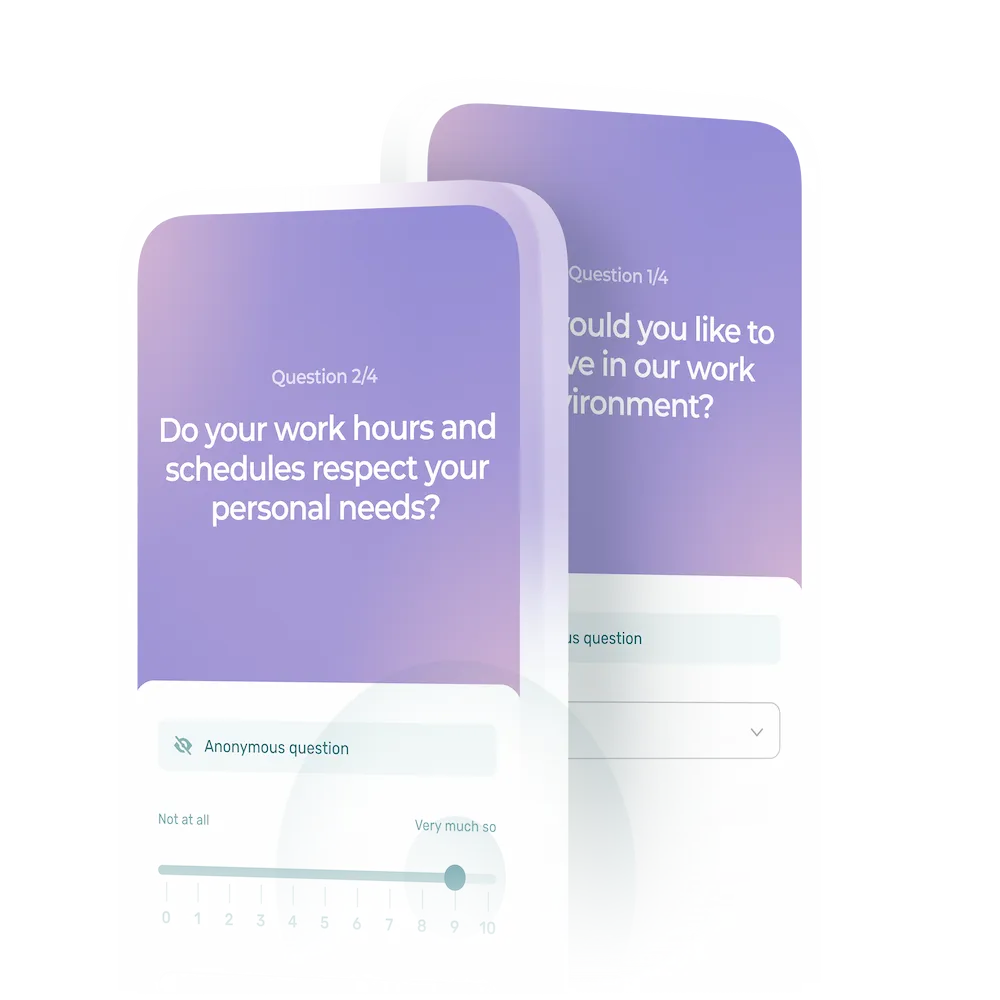
- Make it asynchronous. Not everyone wants to flag a problem out loud, in front of coworkers, in the middle of a busy Friday night shift. Why not offer your team the option to provide anonymous feedback through short employee surveys? Or open discussion in your communication app either in private chats or with team-wide messages? People will be able to raise things when they have the time and headspace to articulate them.
- Close the loop, even when the answer is no. The fastest way to kill pushback is to ignore it. The second fastest is to fix things silently. If you change something based on what an employee flagged, tell them. If you decided not to, tell them why. Both keep the channel open.
Improve team productivity with Agendrix
Some of what your team needs to tell you won’t come up in a shift handoff. That’s why Agendrix has a few different ways for it to surface.
- Surveys for the things people won’t say out loud. Anonymous, short, and pulse-checked across the team, so you spot patterns before they escalate.
- Messenger for the things that come in real-time. Private chats when an employee wants to flag something one-on-one, group chats when the issue affects the whole crew.
- News feed for the things you decide to act on. Closing the loop publicly (here’s what we heard, here’s what we’re changing) is what keeps the channel open.
Three small surfaces, one shared idea: pushback should be easier than working around the problem.
Stop mistaking quiet for productive
The team you’re really aiming for isn’t the one where nobody complains. It’s the one where everyone feels accountable for flagging what’s broken, and where management is accountable for what happens next.
Honesty cuts both ways: employees tell you what isn’t working, and you own the fixes (or the reasons you can’t).
What is employee pushback in the workplace?
Employee pushback is when a worker openly questions, disagrees with, or flags a problem about a process, tool, schedule, or decision. It’s often mislabeled as negative attitude or resistance, but in healthy teams, pushback is usually a form of operational feedback. Employees closest to the work see things managers can’t, and pushback is how that information surfaces.
What's the difference between employee feedback and employee voice?
Employee feedback is usually formal: surveys, reviews, structured check-ins. Employee voice is broader, it covers any way an employee communicates input about how the work is done, including informal pushback during a shift. Voice tends to surface operational issues faster than formal feedback programs, because it doesn’t wait for a survey cycle.
Why does listening to employees improve employee productivity?
Frontline employees have direct visibility into operational friction, broken processes, and inefficient workflows that managers rarely see. When companies act on that input, they fix problems that compound over time and improve employee productivity. Recent MIT Sloan research found that manufacturers who incorporate front-line worker feedback see 16% higher productivity than those who don’t.
What happens when employees stop pushing back?
When employees stop pushing back, they start routing around problems instead of fixing them. Schedule issues get traded off the books, broken processes get bypassed with workarounds, and the actual operating system of the business stops matching the documented one. Employee productivity declines as your most experienced employees burn out doing the invisible work of compensating, and they eventually leave.
How do I tell useful employee pushback from complaining?
Ask four questions:
- Is it specific?
- Does it repeat?
- Would fixing it save time or reduce errors?
- Is the person normally engaged?
If most answers are yes, you’re looking at signal, not noise. Specific, repeating complaints from your most invested employees are almost always worth acting on.
How do I respond to employee pushback in the moment?
When an employee pushes back in the middle of a shift, your goal isn’t to resolve it on the spot. It’s to acknowledge what they said, ask one or two clarifying questions, and tell them when you’ll get back to them. Then actually get back to them. Closing the loop, even when the answer is we can’t fix this right now, is what separates managers who get useful feedback from ones who don’t.
How often should I ask employees for feedback?
Ask for employee feedback often, but informally. Daily 30-second check-ins at shift handoff and a weekly 5-minute one-on-one tend to surface more useful information than quarterly engagement surveys. Over-surveyed teams stop giving honest answers, so formal feedback programs work best when they’re infrequent (once or twice a year) and built on top of an ongoing informal habit.
How can SMB owners build a feedback culture without a formal HR program?
You don’t need an HR department. You need a habit. Build a 30-second check-in into shift handoffs, make it possible for employees to flag problems asynchronously through a messaging tool, and always close the loop when something is flagged. The structure is less important than the consistency.
What's the biggest mistake managers make with employee feedback?
Collecting it and not acting on it. The fastest way to train a team to stop pushing back is to ask for input and then change nothing. Even worse: ignore an employee’s feedback for months, then implement the same idea later as if it were a management initiative. Both kill the channel.