

Key takeaways
- A clopening means closing one night and opening the next morning with very little rest in between.
- Forced on people, it wears teams out: lost sleep, more mistakes and accidents, lower morale, turnover.
- It isn’t illegal on its own in Canada, but the rest rules around it depend on whether you fall under provincial or federal jurisdiction, and on any collective agreement.
- A scheduling app flags two shifts that sit too close together, before the schedule ever goes out.
Lock up the store at 11 p.m., then unlock it again at 5 a.m. In between, barely enough time to sleep. That’s a clopening shift. It’s common in retail and restaurants, and it drains your staff faster than you’d think. But is it always a bad call? Not necessarily.
So what exactly is a clopening?
A clopening is a closing shift followed right away by an opening shift, with very little rest between the two. The word is a blend of the “closing” and “opening.”
Here’s what it looks like in practice. Molly closes the café where she works at 11 p.m. on Tuesday. The next day, she’s scheduled to open at 6 a.m. Between the end of her shift, the commute home, going to bed and waking up, she’s left with barely five hours to sleep. And yet she works both shifts back to back.
Clopenings show up most in workplaces with variable hours:
- 🍽️ Restaurants and bars
- 🛍️ Retail stores and convenience stores
- 🏥 Healthcare and seniors’ residences
- ⛽ Gas stations and late-night businesses
Any time a business closes late and opens early, or runs almost around the clock, the odds of scheduling a clopening go up.
Why managers end up scheduling clopenings

Few managers hand out a clopening out of bad intent. Most of the time, circumstances force their hand. Here are the usual culprits.
Short-staffing. With a small team, the same people have to cover both the close and the open. When someone calls in, the clopening often becomes the quick fix.
Few people trained to open and close. Cashing out, making a deposit, firing up the kitchen: these tasks usually take training, or a level of experience and comfort not everyone has. So they keep landing on the same small core of staff.
Scheduling by hand. When the schedule lives in an Excel file or on paper, a closing shift followed by an opening slips through easily. The mistake only surfaces once the schedule is out, sometimes when the employee spots it themselves.
What a forced clopening does to your staff
The problem isn’t the shift itself, it’s the missing rest that comes with it. When someone goes straight from closing to opening, they get only a few hours to recover before starting over. And the fallout follows.
The research on short intervals between shifts (what researchers call “quick returns,” meaning fewer than 11 hours between two shifts) is telling here. Carried out mostly in hospital settings, it links these short gaps to less restful sleep, more drowsiness on the job and a higher injury risk than a normal rest period. A store or restaurant isn’t a hospital, but the underlying mechanism is the same: less rest, more fatigue, more risk.
The real problem with a clopening is never working two shifts in a row. It’s the missing rest the employee is stuck with.
For staff with family responsibilities, a clopening also throws off childcare and the logistics of everyday life. Fatigue piles onto the pressure, and goodwill toward the employer wears thin.
A cost that lands back on the business
The fatigue doesn’t stay on the employee’s side. A clopening forced on people again and again ends up costing the business itself. A worn-out employee serves customers less well, makes more mistakes, and once it’s too much, walks out the door.
Piling on punishing schedules pushes your best people toward the exit, and then you spend to recruit and train their replacements. A forced clopening feels like saving on labour in the short term, when it’s really feeding a much bigger expense: staff turnover.
Are clopening shifts legal in Canada?
Straight question, nuanced answer. A clopening isn’t banned as such: no law names the practice to outlaw it. What governs it are the rules on rest, and those shift depending on your business’s situation.
Across most of Canada, employment standards fall under provincial or territorial law, and the default is thinner than you’d expect: most provinces guarantee a weekly rest period but set no minimum rest between two shifts at all. Quebec is one example, where the law secures at least 32 consecutive hours off a week but doesn’t floor the gap between a closing and an opening. Where the law stays quiet, a clopening is legal by default, however rough it is on the person working it.
A few jurisdictions go further, and those are the ones that actually keep clopenings in check. Ontario is the strictest of the bunch: employees are owed at least 11 consecutive hours off work each day, plus at least 8 hours off between shifts unless the two together total 13 hours or less. That daily 11-hour floor is the one a clopening runs into: a late close and an early open can quietly break it. British Columbia sets a lighter bar, at least 8 consecutive hours off between shifts. So the very same clopening can be a violation in one province and perfectly legal in the next.
If your business is federally regulated instead (think banks, telecom, interprovincial transport), the Canada Labour Code sets its own floor: at least 8 consecutive hours of rest between work periods or shifts. On top of the law, any collective agreement in force can set the bar higher.
Bottom line: check which rules apply to you before you build the schedule. And remember that legal and wise aren’t the same thing. When in doubt, look up your province’s employment standards or talk to a labour standards professional. For more on the topic, see our guide to breaks at work.
Is a clopening always a bad practice?

Here I’ll be straight with you, because my own experience complicates the usual picture.
In two of my student jobs, I worked clopenings now and then. It wasn’t always pleasant, obviously. But at certain moments, I saw it as a kind of flexibility. Stacking my hours together let me “power through” my week faster and free up whole days afterward to focus on school. There was even an upside to it: closing then opening, I came back to my station exactly as I’d left it, clean and ready to go.
What it taught me is that a clopening isn’t bad in itself. What causes the harm is having it forced on people, and the missing rest. An employee hit with a surprise clopening, or one after another, with no regard for how tired they are, gets the worst version of the practice.
A forced clopening is a scheduling problem. A chosen clopening, with enough rest between the two blocks, is flexibility. The difference comes down to two things: choice and rest.
Depending on their situation, some employees might even prefer this kind of schedule. The key is to ask them rather than decide for them, and to make sure the rest stays sufficient either way. Why not put the question to them through a survey in Agendrix to hear where they stand? 😎
How to avoid (or better manage) clopenings
Good news: a few habits are enough to clear most clopenings out of your schedules, or to keep them in check when they’re wanted.
Ask your team once a season. Some people can’t stand clopenings, others would rather stack their hours to free up days. Ask them straight, ideally when you’re adjusting your template schedules (back-to-school, the holidays, summer). Note who’s fine with this kind of shift and who turns it down, and keep that list handy when you plan.
Post schedules two to three weeks ahead. The earlier the schedule goes out, the more time your staff have to sort things out and swap a shift between themselves before the problem lands back on you. A clopening caught two weeks early gets solved with a simple swap.
Train at least two more people to open and close. This is the real heart of the problem: when only two or three employees know how to start the day or do the end-of-night deposit, the clopening becomes mathematically unavoidable, yourself included. Widening that circle, even by one or two people, kills the constraint at the source.
Let a tool watch the gaps for you. This is often where manual scheduling falls apart: nobody works out in their head the gap between a shift ending at 11 p.m. and another starting at 5 a.m. A scheduling app like Agendrix lets you set a minimum rest period between two shifts, say eight hours. The moment you try to post a schedule where two shifts sit too close for the same employee, the tool warns you, before the mistake goes out to the whole team. You stay in control, without playing detective.
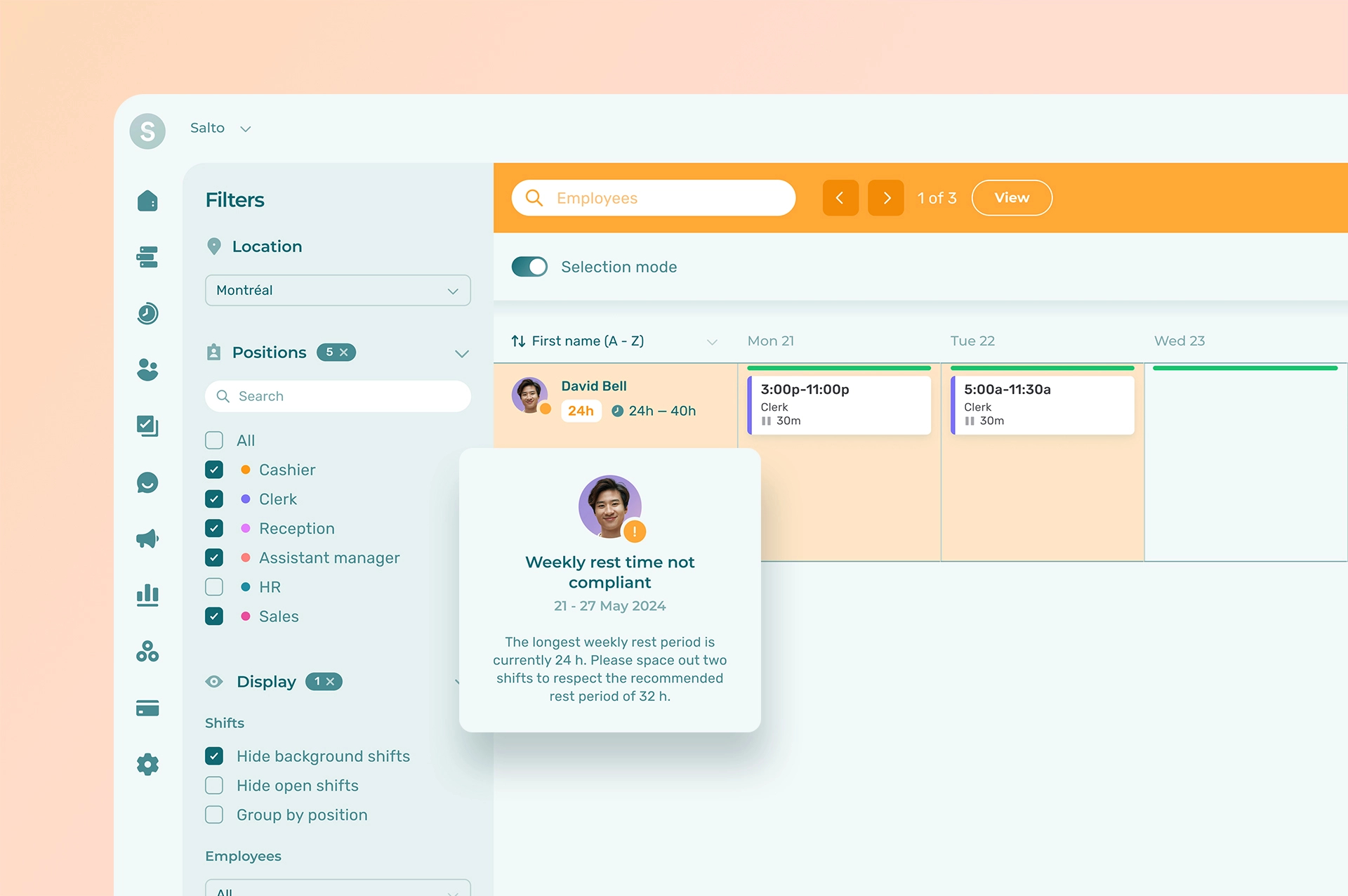
The goal isn’t to ban every clopening on principle, but to make sure none slips into the schedule without you seeing it and intending on planning it.
The right shift, at the right time, for the right person
A clopening isn’t a practice to rule out from the start. It’s a signal. When it keeps forcing its way into your schedules, it usually points to short-staffing, a training gap or a scheduling tool that can’t keep up. Fix that, and the clopening question changes shape: no longer “how do I impose it,” but “who on my team would actually welcome it.” That’s a much better question to be asking.
What is a clopening (or clopening shift)?
A clopening is a closing shift followed right away by an opening shift, with very little rest in between, sometimes under five hours. The term is a blend of “closing” and “opening.”
Is clopening illegal in Canada?
A clopening isn’t banned as such. It’s the rest rules that govern it, and they depend on whether you’re covered by provincial or federal law and on any collective agreement. In Ontario, for instance, employees are owed at least 11 consecutive hours off each day, which a clopening can breach. When in doubt, check your province’s employment standards or talk to a labour standards professional.
How many hours of rest are required between two shifts?
It depends on your situation. In Ontario, employees are entitled to at least 11 consecutive hours off work each day, plus at least 8 hours between shifts unless the two total 13 hours or less. Federally regulated workplaces owe at least 8 consecutive hours of rest between shifts under the Canada Labour Code. Rules differ across the other provinces, and a collective agreement can set a higher floor.
Why do employees hate clopenings?
Because a forced clopening eats into their night’s sleep. The missing rest brings on fatigue, mistakes and low morale, and it complicates personal life, especially for those with family responsibilities.
Is a clopening always a bad thing?
No. The problem comes from imposing it and from the missing rest, not from the two-shift block itself. Some employees prefer to stack their hours to free up whole days. The key is that the shift is chosen rather than forced, with enough rest in between.
How do I avoid scheduling clopenings by accident?
Ask your team for their preferences, post schedules well ahead of time, train more people to open and close, and use a scheduling app that alerts you when two shifts sit too close together for the same employee.